Men's Health
·16 min read
The Copper Signal: What GHK-Cu Does for Men's Hair Growth
A tripeptide your own body has made since birth has become the most talked-about molecule in men's hair. The catch, and the opportunity, is that its payoff depends far less on the molecule than on you.
By Tony Medrano
This article is for education and is not medical advice.
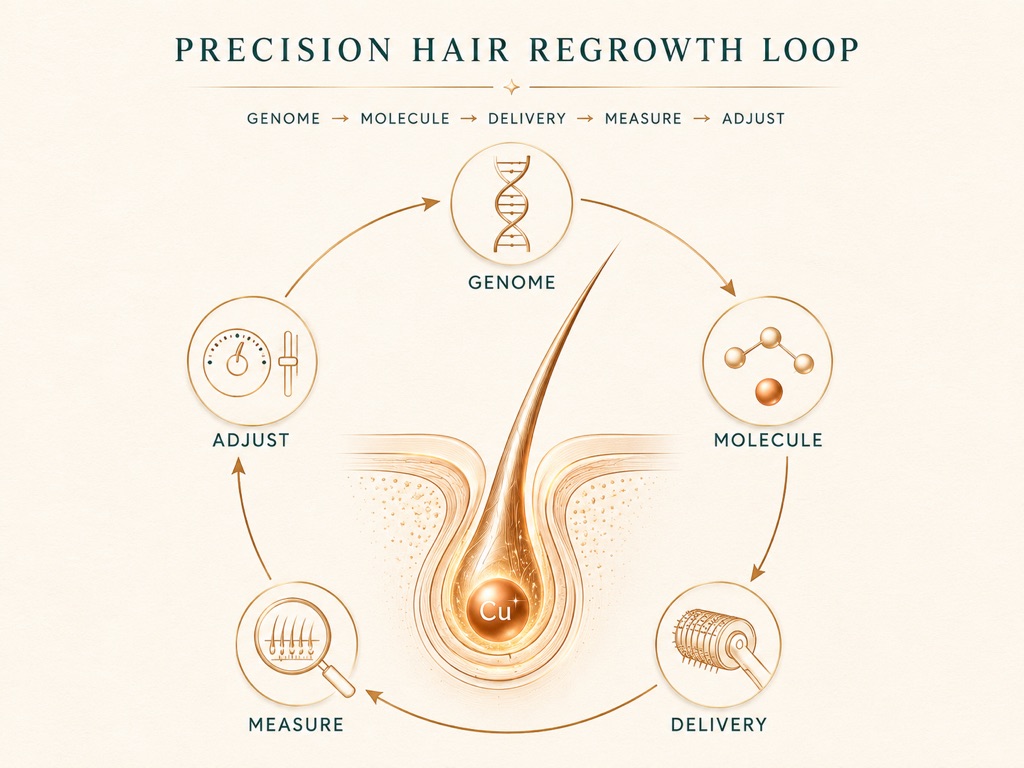
Bryan Johnson's data-driven hair protocol models the whole idea in one loop — read the genome, choose the molecule, engineer delivery, measure, adjust. GHK-Cu is one of the most interesting molecules to run through it.
When Bryan Johnson — the entrepreneur who sold Braintree to PayPal and now spends a reported $2 million a year reverse-engineering his own biology on camera for Netflix — set out to regrow his hair, he did not start at the pharmacy shelf. He started with a genetic test that predicted how he would respond to specific ingredients, and only then commissioned a custom topical formula built around that readout.22 His peptide serum lists Copper Tripeptide-1 — the cosmetic name for GHK-Cu — alongside a nanoliposome delivery system, and he intermittently microneedles his scalp to help it penetrate.23 When his bloodwork later showed his DHT had dropped too low, he adjusted the protocol and moved on.22
Strip away the theatrics, and Johnson has quietly modeled the entire thesis of this article. He treated his own head like a system: read the genome, choose the molecules, engineer the delivery, measure the response, adjust. That is not a hair routine. That is precision medicine with a mirror. And GHK-Cu — a fragment of your own plasma, three amino acids wrapped around a copper ion — turns out to be one of the most interesting molecules to run through that loop. This is the story of why, told with the numbers, the honest caveats, and the reasons a well-run peptide plan is one of the most compelling tools in modern longevity work.
A signal your body already knows how to hear
Here is what makes peptides such a promising frontier, with GHK-Cu as the flagship example. These are not foreign chemicals engineered to force an outcome. They are the body's own messengers — short chains of amino acids that cells have been translating for millions of years. GHK-Cu was isolated in 1973 by biochemist Loren Pickart, who observed that liver tissue from older donors began to behave like that of younger donors when bathed in plasma from younger donors. The active fraction was this tiny copper-binding tripeptide.3
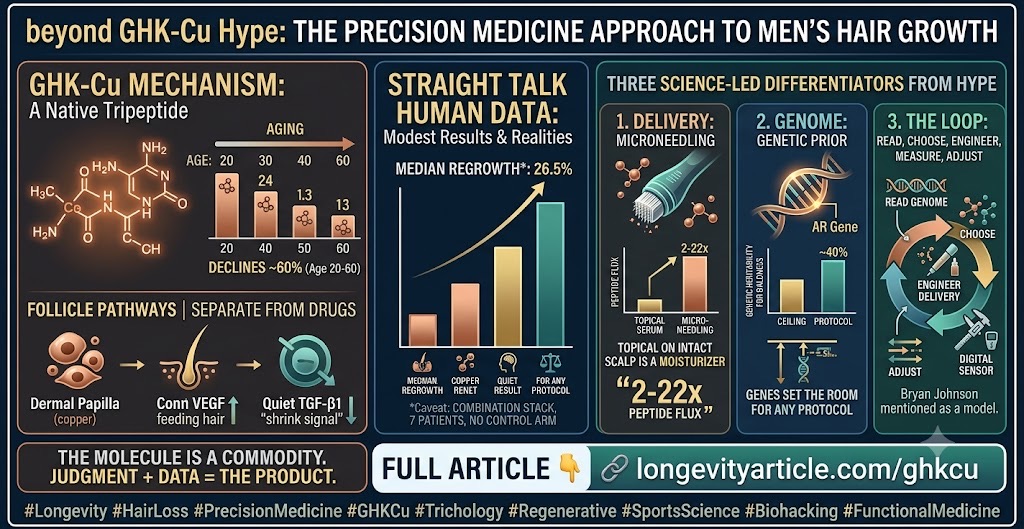
Your body is fluent in it — and then, slowly, it stops speaking. Plasma GHK falls from roughly 200 ng/mL at age 20 to about 80 ng/mL by age 60, a ~60% decline that shadows the fade of wound healing, skin repair, and follicle vigor.4 The premise of restoring it is therefore not exotic; it is the replacement of a signal you were born rich in.
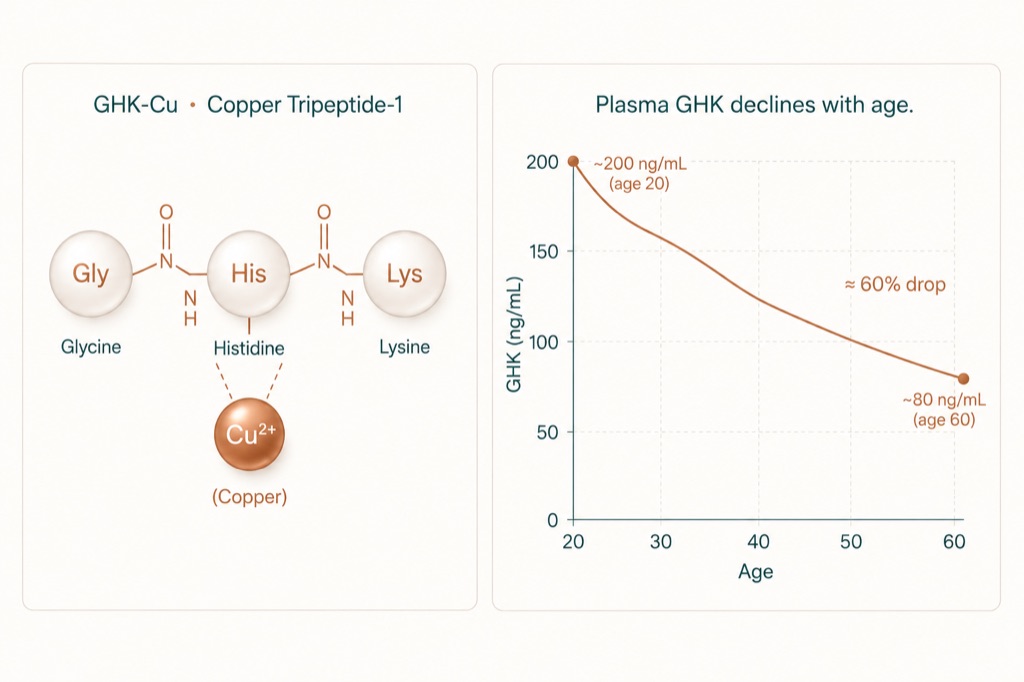
GHK-Cu is a fragment of your own plasma — glycine, histidine, and lysine bound to copper. Your body makes roughly 60% less of it at 60 than it did at 20.
And GHK-Cu does not whisper to a single receptor. It is a pleiotropic conductor. Analyzing the Broad Institute's Connectivity Map, Pickart and Anna Margolina reported that the peptide modulates the expression of roughly 31% of human genes, tilting antioxidant defense, DNA repair, and tissue remodeling up while turning inflammatory and pro-fibrotic programs down.3 Its day job is copper logistics — delivering copper to enzymes such as lysyl oxidase that cross-link collagen and elastin. In classic fibroblast work by Maquart and colleagues, collagen synthesis was stimulated at concentrations as low as 10⁻¹² M.13 Decades of documented wound-healing and skin-regeneration results sit behind it. When people call GHK-Cu a "restoration" molecule rather than a drug, that is the distinction they mean, and it is a fair one.
What it does at the follicle
Male pattern hair loss is not a single switch flipping off. Modern genomics reframes androgenetic alopecia (AGA) as a polygenic process: DHT sensitivity in genetically susceptible dermal papilla cells sets off a cascade — withdrawal of growth-factor support (VEGF, IGF-1), loss of Wnt/β-catenin signaling, low-grade perifollicular inflammation, and breakdown of the matrix around the follicle. Across successive cycles, thick terminal hairs shrink toward fine vellus wisps.9
Copper peptides are compelling precisely because they act on several of those downstream nodes through a route entirely separate from the DHT axis that finasteride blocks and the vasodilation that minoxidil relies on. The foundational tissue study by Pyo and colleagues at Seoul National University showed that a copper tripeptide complex lengthens human hair follicles in culture, multiplies dermal papilla cells, increases VEGF, and lowers TGF-β1 — the very signal that pushes a follicle out of its growth phase.1 In plain terms: it feeds the follicle's blood supply, nourishes its command cells, and quiets the shrink signal.
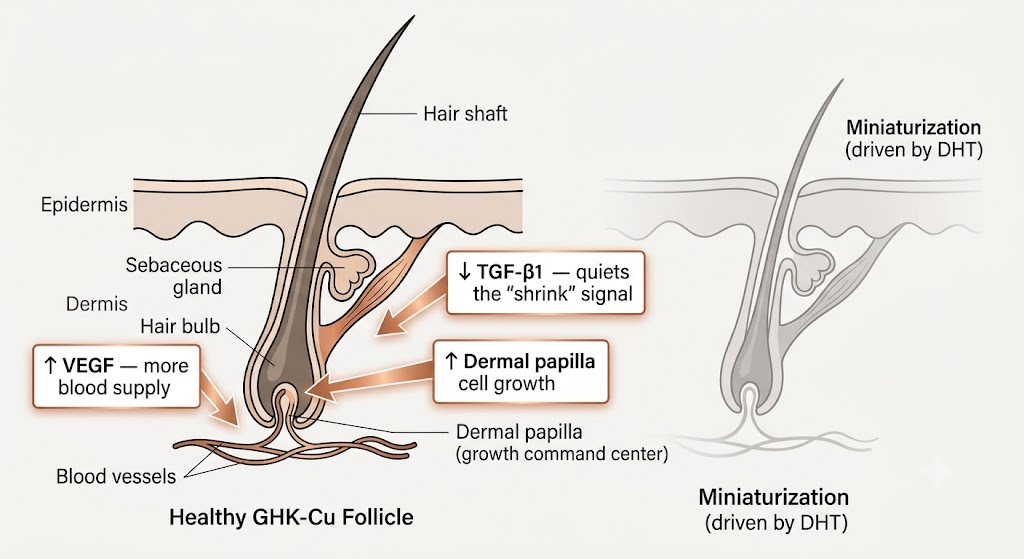
GHK-Cu acts through a different route than minoxidil or finasteride — feeding blood supply, nourishing the dermal papilla, and turning down the TGF-β1 signal that shrinks hairs.
A mark of rigor, not a gotcha. That famous Pyo study actually tested AHK-Cu, a close structural cousin of GHK-Cu — not GHK-Cu itself.1 The mechanisms overlap heavily, and both belong to the same promising copper-peptide family, but a careful practitioner names the exact molecule in the exact study. Getting this right is what separates a science-led plan from a screenshot passed around a forum.
Why practitioners are betting on peptides
Zoom out from the scalp, and you can see why the sharpest people in performance and aesthetics — the weight-loss coaches, performance coaches, dietitians, executive coaches, nutritionists, and health-and-beauty advisers whose reputations ride on client results — have leaned into peptide science so decisively. Their edge has always been the ability to turn frontier research into outcomes a client can feel and see. Peptides reward exactly that skill set. They are body-native, they generally have excellent safety profiles, and the mechanistic literature is deep enough to build intelligent protocols on top of — GHK-Cu's gene-expression breadth, its collagen and VEGF effects, its TGF-β1 suppression, and its long regenerative track record in wound care.3,13
The professional who can explain why a molecule should help, set honest expectations, layer it correctly, and then measure whether it worked is operating in a different league from the influencer selling a jar of hope. That is the whole game, and it is a flattering game for the well-informed. LongevityPlan.AI exists to hand that practitioner the science, the peptide fluency, and the performance-optimization tooling to lead their field rather than chase it — to be the Coach / Practitioner clients trust with the questions that actually matter.
Read more scientific research from LongevityPlan.AI, or buy peptides from our shop.

The molecule is the commodity; the judgment around it is the product. Coaches, dietitians, and practitioners who can explain, deliver, and measure a protocol operate in a different league.
What the human data shows — read this before you promise anything
Optimism and honesty are not enemies; the best practitioners hold both. So here is the human picture, told straight. The most-cited clinical result for copper peptides in hair is a 2025 study in JAAD International by Kuceki, Carlos Wambier, and colleagues across Brown, Utah, Yale, and São Paulo.2 Over five monthly "tattooing" microneedling sessions, patients saw a median 26.5% total scalp-area regrowth, SALT scores falling from a median of 40% to 7.5%, and zero adverse events. Genuinely encouraging — and worth quoting with its fine print intact:
- It was a combination of minoxidil 5% + dutasteride 0.25% + copper peptides delivered together — not copper peptides alone, so the 26.5% belongs to the stack, not to GHK-Cu.
- It enrolled seven patients, all of whom had already failed a year of standard therapy.
- There was no control arm — a limitation the authors themselves flag.
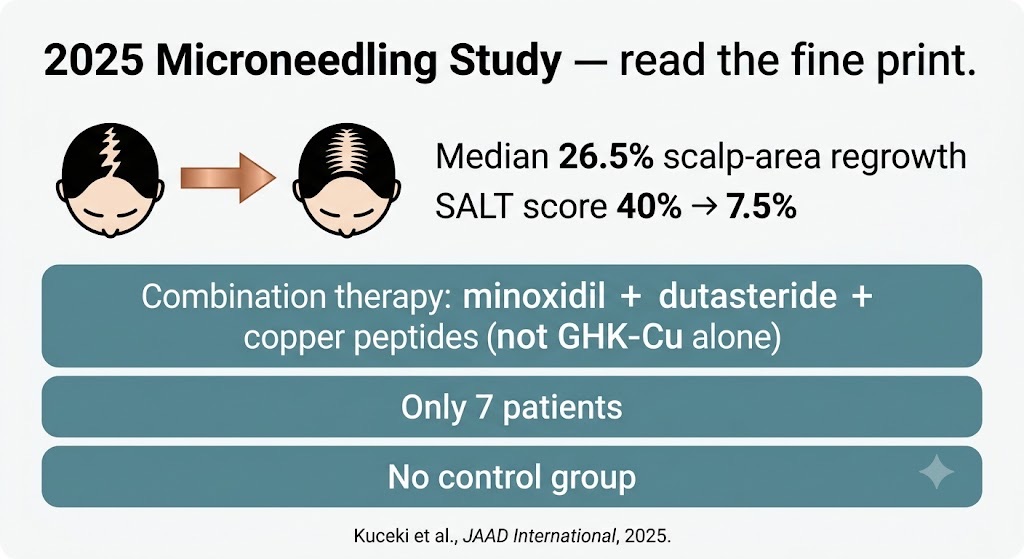
The most-cited copper-peptide hair result is genuinely encouraging — and honest reading matters: it was a combination therapy in seven patients with no control arm.
Read correctly, this is a promising signal for delivery-enhanced combination Peptide Therapy, and a preview of where the field is heading — not proof that a copper peptide out-grows minoxidil on its own. (The widely repeated claim that GHK-Cu triggers "faster anagen initiation, 6 versus 9 days" appears in no primary study we could locate; treat it as folklore until a citation surfaces.) A rigorous 2026 gerontology review in Frontiers in Aging reaches the same balanced verdict: the transcriptomics are exciting, and the controlled human outcomes are still being written.12 For the professional, that gap is not bad news. It is job security — because closing it, for one specific client at a time, is precisely the work.
Unlock one: delivery is what makes it work
If the mechanism is sound but topical results are erratic, physics is usually the culprit. GHK-Cu is water-loving; the outer skin barrier is built to keep water-loving molecules out. This is why every credible human hair result pairs copper peptides with a delivery method — nanoliposomes, a microneedle roller, or both.
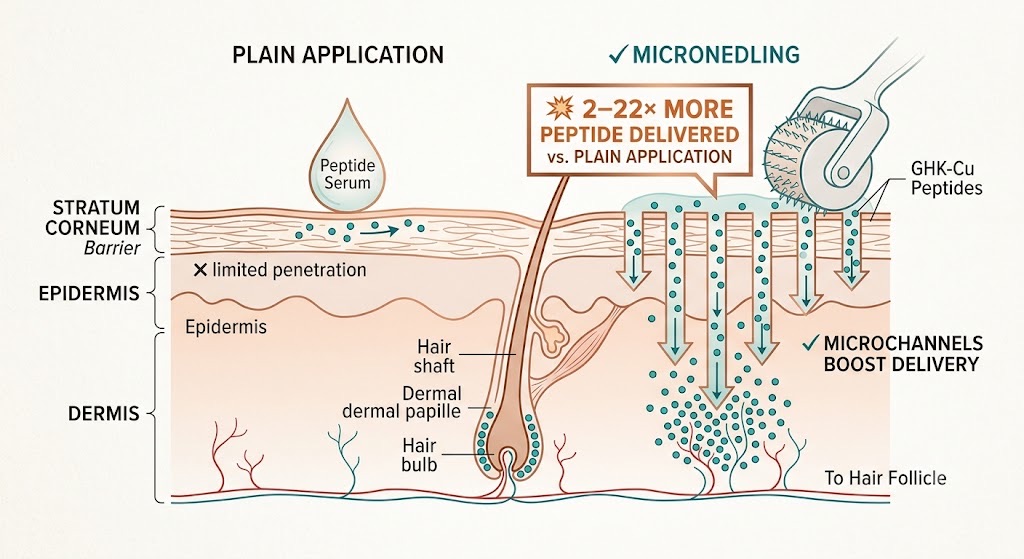
GHK-Cu is water-loving, and the skin barrier is built to block such molecules. Microneedling opens microchannels that raise peptide delivery 2- to 22-fold, which is why serious results pair the serum with a delivery method.
The delivery science is quantified. In controlled human skin studies, microneedling increased the delivery of small cosmetic peptides by 2- to 22-fold over passive diffusion;5 in a separate study, a 31-fold increase in flux of a small peptide was measured after microneedle pretreatment.6 Formulation matters just as much as needles: published hair formulas cluster in the 1–5% copper-peptide range, and the follicle effects appear at far lower concentrations — because copper peptides follow a biphasic curve where too much can inhibit the very cells you want to wake up.1 More is not better; delivered correctly is better. A serum on an intact scalp is mostly a moisturizer. The same serum, delivered through microchannels at the right dose, is an entirely different intervention.
Unlock two: your genome decides who responds
This is the layer the drugstore aisle structurally cannot reach — and where opening with a genetic test stops looking eccentric and starts looking like foresight. AGA is heritable and deeply polygenic. Variation in the androgen receptor (AR) gene alone accounts for roughly 40% of the heritability of male pattern baldness;8 a landmark 2005 study named AR variation the single major determinant of common early-onset loss.7 Beyond AR, genome-wide studies map dozens of loci onto androgen signaling, WNT/TGF-β, apoptosis, and follicle development9 — and, tellingly, risk variants found in one ancestry often fail to transfer to another.9
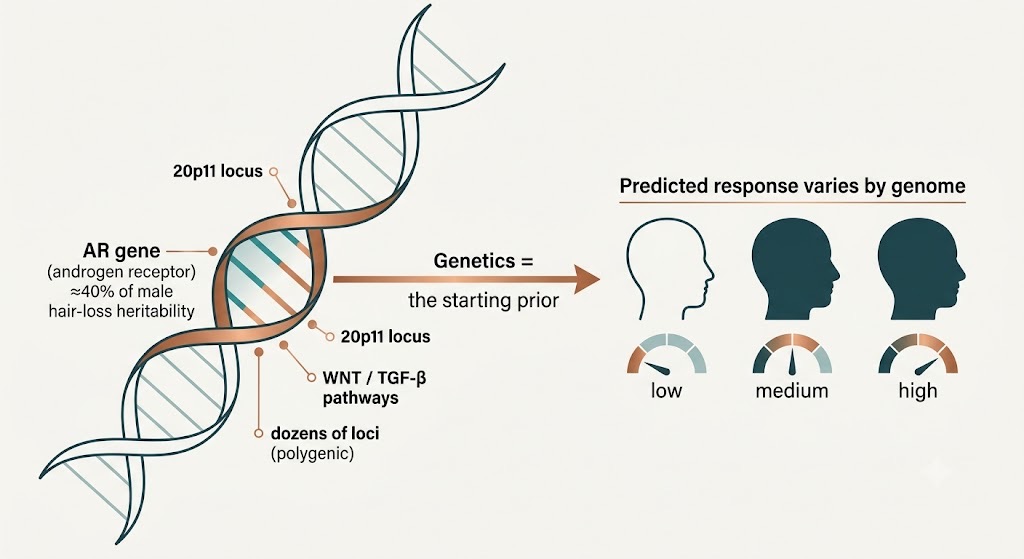
Hair loss is polygenic — the androgen receptor gene alone explains about 40% of the heritability. Your genome is the prior probability that sets how much room any protocol has to work.
Two consequences fall straight out. First, the pathways GHK-Cu touches — TGF-β1, Wnt, apoptosis — are the same nodes where your genome may already be tilting the outcome, so the peptide's leverage is not fixed; it depends on your starting architecture. Second, drug response is genetically stratified, which is why finasteride and minoxidil help some men dramatically and others barely, even when they look clinically identical.
This is the foundation of the Digital Twin for Predictive Peptide Performance™: characterize the individual before layering any protocol on top of guesswork. Partners like The Genomics Company supply the germline layer — the AR and pathway-relevant variants that shape whether an intervention has room to work. Genetics is not destiny here; it is the prior probability. It tells a practitioner where to spend a client's time, money, and patience before a single needle touches skin — which is exactly, and not coincidentally, how Johnson began.
The loop: from molecule to model to result
Borrow the discipline from the places that treat human performance as an engineering discipline. NASA models astronaut physiology before a mission, not after. Formula 1 lets telemetry, not intuition, set up the car. Two decades of sports science say the athletes who improve fastest are the ones whose interventions are measured. Hair is a near-perfect small-scale test bed for the same philosophy, because the follicle hands you a countable, photographable output.
A serious plan assembles this in layers. The sensor layer captures multi-modal health data: standardized trichoscopy for hair density and caliber, bloodwork for the reversible saboteurs (ferritin, vitamin D, thyroid, androgens), and the genomic report. The intelligence layer turns that into predictive modeling — given this genotype and this baseline, what regrowth trajectory is realistic, and which lever moves it most? Then the loop closes: re-measure at three, six, and twelve months (six being the minimum honest window for any hair intervention) and adjust. This is the whole of it, stated once so it lands: read the genome, choose the molecules, engineer the delivery, measure, adjust.
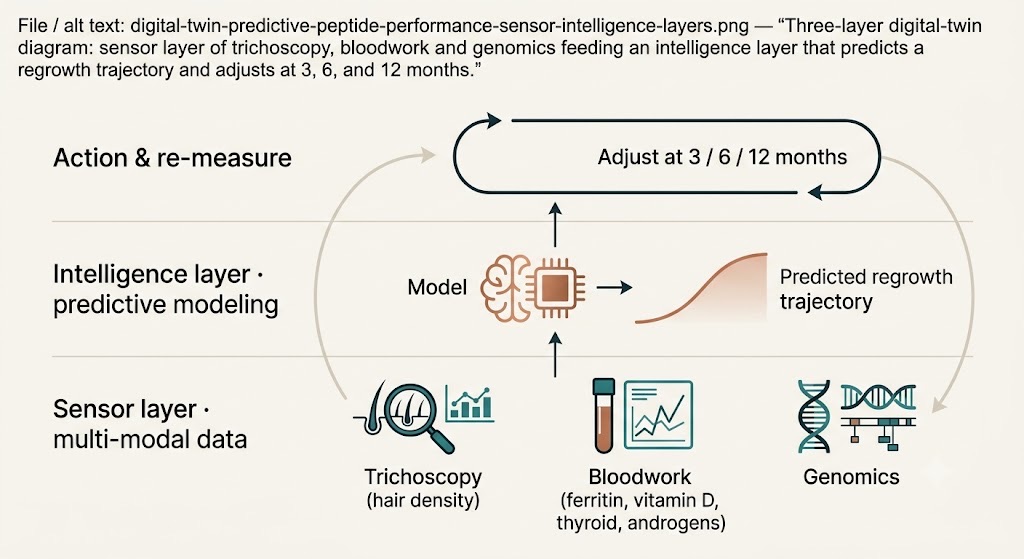
A Digital Twin for Predictive Peptide Performance turns hair density, bloodwork, and genomics into a realistic forecast — then closes the loop by re-measuring and adjusting.
Here, the AI earns its place — not by inventing a molecule, but by refusing to let an Athlete / Patient chase a protocol their own data predicts won't respond, and by catching the iron or thyroid problem a serum would have silently failed to fix. Those are the AI-powered coaching improvements that actually matter: fewer heroic interventions, better-aimed ones, and an honest scoreboard the practitioner and client can read together.
So where does GHK-Cu itself sit? On the honest evidence, as a well-tolerated, mechanistically rich adjunct — excellent to layer onto a scalp already getting proven agents and proper delivery, exactly as it shows up in the most-documented real-world stacks. In a category crowded with compounds carrying worse safety and thinner mechanisms, "body-native, plausible, and best used in a smart stack" is a genuinely strong position — and a molecule a practitioner can stand behind without overselling.
Safety and status: the sober, reassuring footnotes
Two practical notes. On safety: topical GHK-Cu has decades of cosmetic and dermatological use with no serious adverse-event signal in the literature, though it lacks large, long-term controlled trials — generally summarized as "reassuring track record, incomplete formal file."12 On competition: GHK-Cu is not on the World Anti-Doping Agency's prohibited list as a topical cosmetic peptide, unlike several growth-factor and hormone-axis compounds — but rules and formulations evolve, so competitive athletes should verify current status rather than trust a blog.
There is also a cultural tailwind worth naming. The stigma around men treating hair loss has collapsed; what was once whispered is now a normal line item in the same optimization budget that funds bloodwork, a trainer, and a sleep tracker. Bryan Johnson filming his scalp for a Netflix audience is the loud version of a quiet shift. The reader who wins from it is the one who treats the whole enterprise the way a good team treats a season — baseline the data, model the realistic ceiling, intervene where the evidence says there's room, and check the scoreboard at six months.
The bottom line
Why does GHK-Cu work "so well" for men's hair? The truthful, more useful answer: it acts on the right pathways, it is remarkably safe, its early combination data are encouraging, and its real-world payoff depends more on delivery and your genome than on the molecule itself. That is not a hedge. It is a map — one that tells you what to buy (delivery-aware protocols, not miracle jars), what to test (your genomic prior and your reversible biomarkers), and how to judge success (a countable change at six months, not a feeling at six weeks).

The people who age best rarely have secret compounds — they have better questions and better instruments. Every good plan starts the same way: with a baseline.
It is worth staying humble about how much any of us really knows in a field this young — and that humility cuts in a hopeful direction: the people who age best rarely have access to secret compounds. They have better questions and better instruments. A copper peptide your body has been making since you were twenty is a fine place to practice asking them — and a good reminder that the most powerful longevity tool is not the newest molecule, but the plan that knows whether the molecule is right for you.
Sign up for FREE daily Longevity Club Workshops, or join the Affiliate Program (pays 20%). Subscribe to the Longevity & Peptide Optimization Newsletter.
About the Author
Tony Medrano is CEO and co-founder of LongevityPlan.AI, a platform that integrates performance and health data and leverages proprietary Digital Twin for Predictive Peptide Performance™ technology, wearable data, and biomarker data to deliver personalized optimization and longevity recommendations. A 3x technology/AI company CEO with 2 successful exits, Tony has completed 3 Full Ironman Triathlons (140.6 mi) since 2019. He holds degrees from Harvard University, Columbia University, and a JD/MBA from Stanford University, and has worked with the US Olympic Team, the NBA, NFL, MLB, NASA, Google, Microsoft, and Netflix, among others. He also served as a US Navy Officer commanding an emergency response team aboard a destroyer.
Disclaimer: This article is for educational purposes and is not medical advice. Injectable and compounded GHK-Cu is not FDA-approved; topical cosmetic use is a different regulatory category. Hair-loss treatment decisions should be made with a qualified clinician who can interpret your individual results and rule out reversible causes.
Endnotes and references
- Pyo HK, Yoo HG, Won CH, et al. "The effect of tripeptide-copper complex on human hair growth in vitro." Arch Pharm Res. 2007;30(7):834–839. PMID: 17703734. doi:10.1007/BF02978833. (Tested AHK-Cu; ex vivo follicle elongation, DPC proliferation, ↑VEGF, ↓TGF-β1; apoptosis reduction not statistically significant.)
- Kuceki G, Coppinger AJ, Ragi SD, Johnson LS, Goren A, Kalil LL, Cirino P, Wambier CG. "Enhanced hair regrowth with five monthly sessions of minoxidil-dutasteride-copper peptides tattooing for androgenetic alopecia assessed by artificial intelligence and blinded evaluators." JAAD Int. 2025;20:38–40. PMID: 40225275. PMCID: PMC11992372. doi:10.1016/j.jdin.2025.01.012. (Combination therapy; n=7; no control arm.)
- Pickart L, Margolina A. "Regenerative and Protective Actions of the GHK-Cu Peptide in the Light of the New Gene Data." Int J Mol Sci. 2018;19(7):1987. PMID: 29986520. PMCID: PMC6073405. doi:10.3390/ijms19071987.
- Pickart L, Vasquez-Soltero JM, Margolina A. "GHK Peptide as a Natural Modulator of Multiple Cellular Pathways in Skin Regeneration." Biomed Res Int. 2015;2015:648108. doi:10.1155/2015/648108. (Plasma GHK ~200 ng/mL at age 20 → ~80 ng/mL at age 60.)
- Mohammed YH, Yamada M, Lin LL, et al. "Microneedle Enhanced Delivery of Cosmeceutically Relevant Peptides in Human Skin." PLoS One. 2014;9(7):e101956. PMID: 25033398. PMCID: PMC4102460. (2- to 22-fold delivery improvement for small peptides.)
- "Enhanced delivery of hydrophilic peptides in vitro by transdermal microneedle pretreatment." PMCID: PMC4590292. (>31-fold flux increase for acetyl hexapeptide-3 after microneedle pretreatment.)
- Hillmer AM, Hanneken S, Ritzmann S, et al. "Genetic Variation in the Human Androgen Receptor Gene Is the Major Determinant of Common Early-Onset Androgenetic Alopecia." Am J Hum Genet. 2005;77(1):140–148. doi:10.1086/431425.
- "Androgenetic alopecia: An update." PMCID: PMC10562178. (AR gene variation ≈ 40% of heritability in men; only finasteride and minoxidil FDA-approved.)
- "The Genetic Landscape of Androgenetic Alopecia: Current Knowledge and Future Perspectives." Biology (MDPI). 2026;15(2):192. (AGA as polygenic; androgen signaling, WNT/TGF-β, apoptosis, follicular morphogenesis; limited cross-ancestry transferability.)
- "Androgenetic alopecia." MedlinePlus Genetics, U.S. National Library of Medicine. (AR variants increase androgen-receptor sensitivity in follicles.)
- Ellis JA, Stebbing M, Harrap SB. "Polymorphism of the Androgen Receptor Gene Is Associated with Male Pattern Baldness." J Invest Dermatol. 2001;116(3):452–455.
- "Therapeutic peptides in gerontology: mechanisms and applications for healthy aging." Front Aging. 2026. doi:10.3389/fragi.2026.1790247. (Restates ~31% gene modulation and plasma-decline figures; notes in vivo functional significance remains to be established in controlled human studies.)
- Maquart FX, Pickart L, Laurent M, et al. Work on GHK-Cu stimulation of collagen synthesis in fibroblasts (effective at 10⁻¹²–10⁻⁹ M), and the 1993 rat wound-chamber study (J Clin Invest) documenting collagen I/III induction.
- "Superpower: 'The era of expensive, inaccessible healthcare is over.'" Longevity.Technology, Nov 2025. (Co-founder Max Marchione on using technology to democratize high-end medicine; ~$199/year, 100+ biomarkers.)
- Function Health company materials and 2026 independent reviews. (Founded 2022 by Dr. Mark Hyman; 100+ biomarkers across two draws; ~$365/year in 2026; clinician notes; optional cancer-screening add-ons.)
- Lifeforce (mylifeforce.com) service description and 2026 reviews. (Co-founded by Tony Robbins and Peter Diamandis; 40–50+ biomarkers; clinician-led telehealth; prescribes hormones and peptides.)
- Badenhorst T, Svirskis D, Merrilees M. "Effects of GHK-Cu on MMP and TIMP Expression, Collagen and Elastin Production, and Facial Wrinkle Parameters." J Aging Sci. 2016;4(3).
- Gorouhi F, Maibach HI. "Role of topical peptides in preventing or treating aged skin." Int J Cosmet Sci. 2009;31(5):327–345.
- Pickart L, Margolina A. "The Effect of the Human Plasma Molecule GHK-Cu on Stem Cell Actions and Expression of Relevant Genes." OBM Geriatrics. 2018;2(3):009. doi:10.21926/obm.geriatr.1803009.
- "Genetic Variants and Lifestyle Factors in Androgenetic Alopecia Patients: A Case–Control Study of SNPs." PMCID: PMC11767835. (AGA risk SNPs at 20p11 and near AR/EDA2R; reduced penetrance implicating non-genetic modifiers.)
- "Microneedle-based cosmetic delivery systems: Advances, applications, and future perspectives." ScienceDirect, 2026. (Review of microchannel-facilitated transdermal delivery of cosmetic actives.)
- Johnson B. "How I Reversed My Hair Loss" and "Bryan Johnson's Protocol." Blueprint (blueprint.bryanjohnson.com), 2024–2026. (Genetic test predicting ingredient response; custom Rx topical; blood-test-driven DHT adjustment; red-light cap; author's stated humility about the early state of anti-aging science.)
- Blueprint Peptide Hair Serum / Haircare Stack product documentation, 2026. (Copper Tripeptide-1 among biomimetic peptides; nanoliposome delivery; microneedling noted to precede application.)