Longevity
·21 min read
Stem Cells and Longevity
What the data really says about stem cell therapy and peptides — and how genomics and AI turn a hopeful injection into an actual plan.
By Tony Medrano
This article is for education and is not medical advice.

For a growing number of high-performing adults, aging is no longer something to accept quietly. Regenerative medicine — from stem cells to peptides — is quietly rewriting how long we get to stay in the game.
In February 2016, at the age of 76, Jack Nicklaus lay on a table in a Munich clinic while a physician performed liposuction on his abdomen, harvested the stem cells from roughly three ounces of his own fat, spun them into a concentrated slurry, and injected them into fourteen separate points along his back and neck.[1] The Golden Bear — eighteen major championships, arguably the greatest golfer who ever lived — had battled crippling back pain since he was a teenager. Cortisone shots and surgery had never solved it. "I was black and blue from the middle of my chest all the way across my hip down to my groin," he later told CNN. "It was not pretty for about 10 days."[1]
Then something happened. Not immediately — that is an important detail we will return to — but over the following months, and especially after rounds of golf, the pain that had shadowed him for six decades quietly receded. Two years later, at a conference in Vatican City, he described his decision in seven characteristically plain words: "I decided to give stem cells a go." He went further, predicting the technology would "change... the direction of orthopedics," and adding a line that is really the thesis of this entire article: "Golf is a game of a lifetime."[2][3]
Nicklaus's story is a near-perfect entry point, because it contains, in miniature, everything the science gets right and everything the marketing gets wrong. It features the body's own repair cells, harvested from the one tissue most of us are trying to lose. It features a delayed, gradual result rather than a miracle. It features a treatment he had to travel abroad to receive. And it features a 76-year-old choosing to invest in the second half of a long, active life rather than accept decline as a foregone conclusion.
What follows is neither a testimonial nor a sales pitch. It is an honest map of the terrain: what the peer-reviewed evidence supports, what it does not yet support, why two people receiving an identical protocol can get opposite results, and how genomics and artificial intelligence are finally converting the hopeful injection into a measured, personalized decision.
What a "stem cell" injection actually is
Start with a correction that reframes everything. The cells at the center of nearly all orthopedic and athletic regenerative therapy are mesenchymal stem cells (MSCs), first characterized by the biologist Arnold Caplan at Case Western Reserve University in 1991.[4] For decades, the assumption was that these cells healed by turning into new tissue — becoming cartilage, becoming tendon, physically replacing what was lost.
Caplan spent the latter part of his career arguing that this picture is largely wrong. In a widely cited 2017 paper, he proposed retiring the name in favor of "medicinal signaling cells," because the dominant effect is not replacement but signaling: the cells travel to a site of injury and secrete a pharmacy's worth of bioactive molecules — growth factors, anti-inflammatory mediators, and tiny packages called exosomes — that calm destructive inflammation and switch the body's own repair machinery on.[4][5] They behave less like spare parts and more like a site foreman who shows up, reads the damage, and tells the local crew what to build.

The modern view of stem cells: they work less like spare parts and more like a site foreman — secreting growth factors, anti-inflammatory signals, and exosomes that switch on the body's own repair crew.
That single reframing carries two practical consequences. First, it explains why the harvested product is so dilute: even in a concentrated bone-marrow aspirate, genuine MSCs make up only about 0.001–0.01% of the cells.[6] Potency is a matter of quality, not volume. Second, it explains the field's pivot toward acellular therapies — delivering the useful signals (the secretome and exosomes) without the cells at all.[5] Hold onto that word, signaling. It is the thread that will connect stem cells to peptides later in this article.
Two harvest sources dominate. Bone-marrow-derived MSCs are the classic option but require an invasive, uncomfortable extraction. Adipose-derived stem cells (ADSCs) — pulled from fat, exactly as in Nicklaus's procedure — have quietly become the favorite for reasons any executive will appreciate: fat is abundant, easy to access, yields far more cells per gram, carries lower patient morbidity, and shows strong blood-vessel-forming potential.[7] The irony is worth savoring: the tissue we spend fortunes trying to shed may be the most convenient repair reservoir we own.
What the evidence actually shows, tissue by tissue
Regenerative claims deserve to be graded by tissue, because the data are genuinely stronger in some areas than others. Here is the honest ledger — strongest signal first.
Cartilage and early osteoarthritis: the most compelling case
This is where the evidence is strongest, and where the patient is most often an active 45- to 70-year-old with an aching knee. The landmark proof-of-concept came from Chris Hyunchul Jo's team at Seoul National University in 2014: eighteen patients received an injection of their own adipose MSCs into an arthritic knee, and at six months the high-dose group showed regeneration of thick, glossy, hyaline-like cartilage covering previously bare joint surfaces — documented on both arthroscopy and MRI.[8]
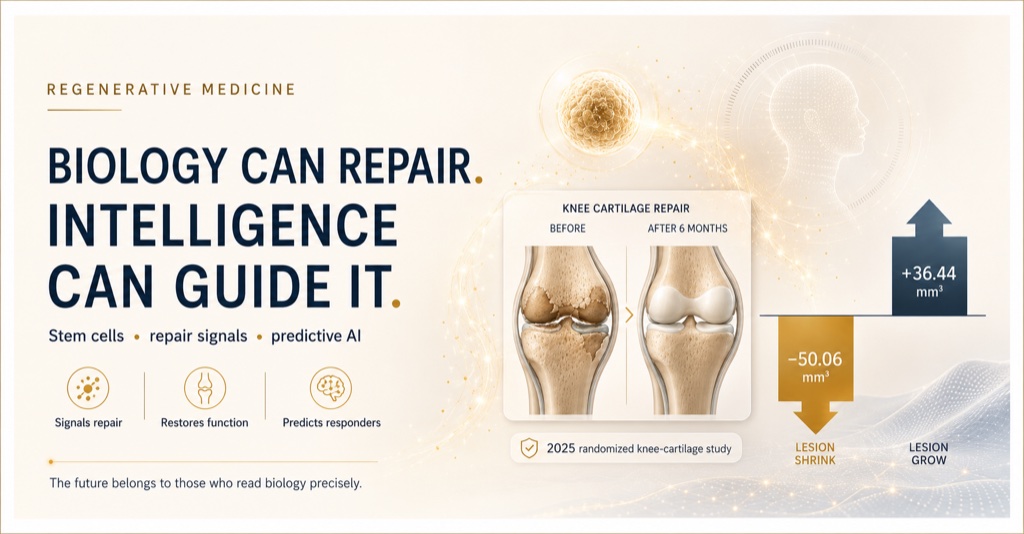
A decade of controlled work has sharpened the picture. A 2025 randomized study comparing ADSC therapy against hyaluronic acid in early knee osteoarthritis found something striking: in the stem-cell group, the cartilage lesion volume shrank by 50.06 mm³, while in the hyaluronic-acid group it grew by 36.44 mm³ — alongside superior, sustained gains in pain, stiffness, and function, and no serious adverse events.[9] A separate review of bone-marrow MSC trials even pinned down a practical dose: roughly 40 million cells appears to be the threshold for meaningful benefit in grade-2-or-higher knee OA.[10] Precision is already showing up in the numbers.
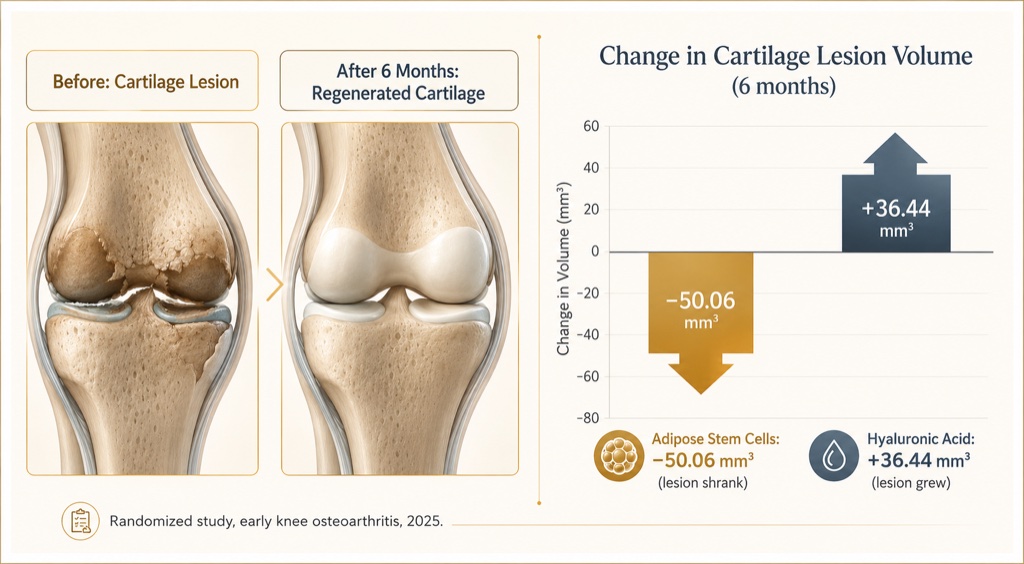
In a 2025 randomized trial of early knee osteoarthritis, adipose-derived stem cells actually shrank the cartilage lesion while a standard hyaluronic-acid injection let it grow — a rare, clean win for regeneration.
Tendon and ligament: promising, still maturing
Half of all sports injuries involve tendons, and tendons heal slowly because they are poorly supplied with blood.[11] A 2025 narrative review in Cureus led by David Koshy reached a measured verdict: platelet-rich plasma shows durable improvement in chronic tendinopathies, and MSCs show promise for improving graft integrity in ligament reconstruction — though inconsistent preparation methods and a shortage of large long-term trials keep firm conclusions out of reach.[12] The mechanistic evidence is more emphatic: a Cambridge systematic review by Victor Lu and Wasim Khan found that every one of the eleven qualifying in vivo studies of MSC-derived exosomes reported better tendon and ligament healing, largely by blunting the initial inflammatory surge.[13] And in rotator-cuff surgery — relevant to anyone over 40, since cuff tears affect roughly a fifth of the population — a case-controlled study by Hernigou and colleagues found that augmenting the repair with bone-marrow MSCs improved healing and reduced re-tears.[14]
Muscle: an early but illuminating mechanism
For muscle, most of the strong evidence is still preclinical, but the mechanism maps beautifully onto both recovery and aging. When ADSCs (or just their secreted vesicles) reach injured muscle, they nudge resident immune cells toward the anti-inflammatory "M2" state and reawaken the muscle's own satellite cells — the stem cells responsible for rebuilding fibers.[15] In animal models, this produces real outcomes: after nerve injury, ADSC injection preserved more muscle mass, grew larger fibers, and reduced fatty infiltration versus controls.[16] "Fatty infiltration of muscle" is not merely an athlete's concern; it is a defining feature of age-related sarcopenia, which is precisely why this research belongs in any serious longevity conversation.
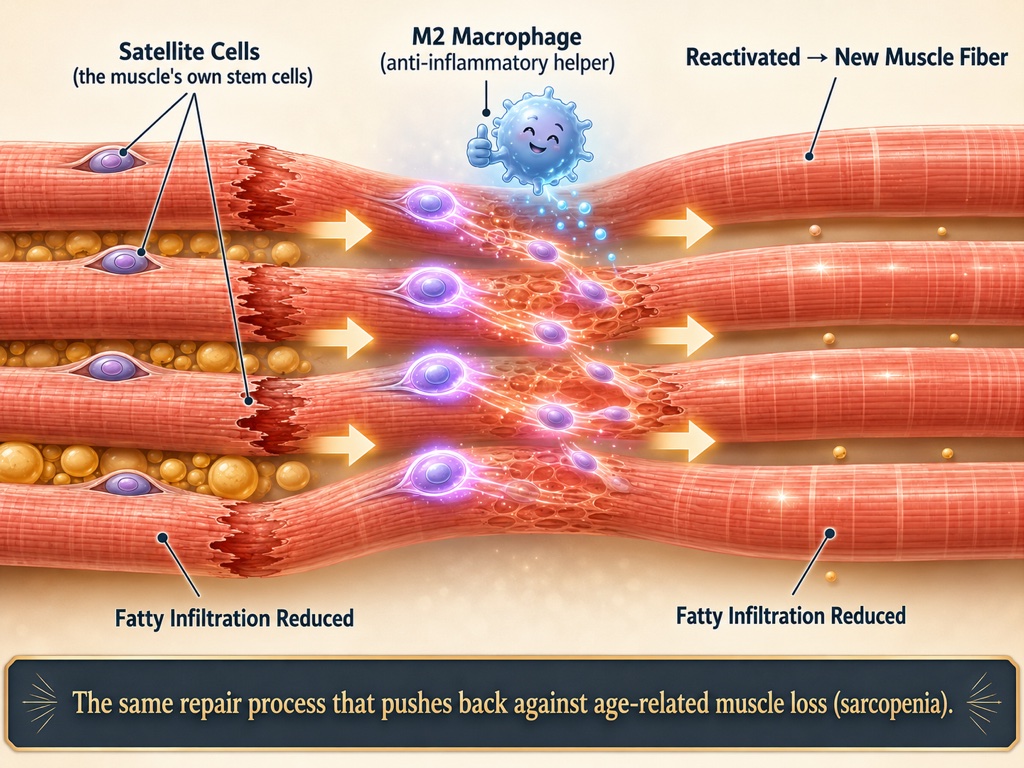
In animal studies, stem-cell signals reawaken the muscle's own satellite cells and shift immune cells into an anti-inflammatory mode — the very machinery that resists the muscle loss of aging.
The honest counterweight. The point of a research brief is candor, so the recurring limitation across every tissue is the scarcity of large, long-term randomized trials and the maddening variability in how cells are harvested, processed, dosed, and delivered — which makes studies hard to compare and outcomes hard to guarantee.[9][12] Caplan himself warned for years that the field's overclaiming misleads the public. Treat cartilage and rotator-cuff data as genuinely encouraging, muscle data as mechanistically promising but early, and any clinic promising a "cure" as a red flag. Recall Nicklaus's own arc: relief came gradually, over months, not overnight. The opportunity is real; so is the noise.
The body's own pharmacy: peptides as signaling molecules
Return to that word — signaling. If mesenchymal stem cells heal primarily by secreting molecular messages, then the most natural companions to regenerative medicine are the messages themselves. That is exactly what therapeutic peptides are: short chains of amino acids, many of them fragments of proteins the body already manufactures, that instruct cells to migrate, divide, build collagen, form blood vessels, or quiet inflammation. Where an MSC is a foreman who secretes signals, a peptide is one of those signals, delivered directly. It is a beautifully economical idea, and it is why peptides have become one of the most exciting frontiers in performance and recovery.
Consider the most-studied example in this space, BPC-157 — a fifteen-amino-acid "body protection compound" originally isolated from human gastric juice.[17] The preclinical record is genuinely impressive. In a transected rat Achilles tendon model, Staresinic, Sikiric, and colleagues reported that BPC-157 restored full tendon integrity, increasing the load the tendon could bear before failing and its stiffness, with superior collagen and fibroblast formation compared to untreated controls.[18] A mechanistic pair of studies from Chang's laboratory in Taiwan then showed how: the peptide accelerates the outgrowth of tendon cells from injured tissue, boosts their migration in a dose-dependent way, and protects them from oxidative stress — all through activation of the FAK-paxillin signaling pathway.[19] In a follow-up, the same group found BPC-157 upregulates the growth-hormone receptor on tendon cells, effectively priming them to respond to the body's own repair hormones.[20] Related work traces its pro-healing effect to the modulation of nitric oxide and new blood-vessel formation — the very angiogenic capability that makes stem cells useful in the first place.[17]
Read More Scientific Researchfrom LongevityPlan.AI.
Read more scientific research from LongevityPlan.AI, or buy peptides from our shop.
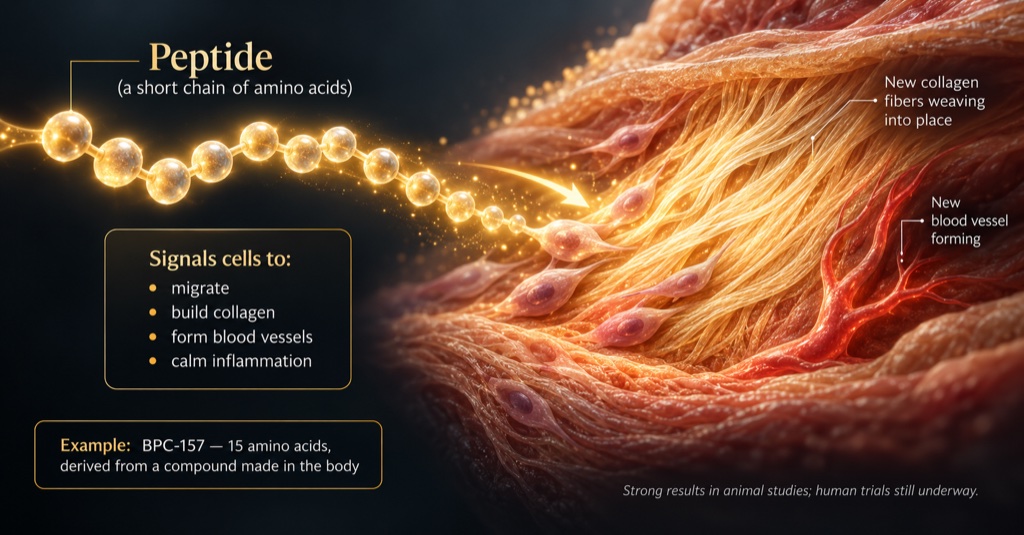
If stem cells heal by sending signals, peptides are the signals themselves. Molecules like BPC-157 — just 15 amino acids, derived from compounds the body already makes — direct cells to migrate, build collagen, and form new blood vessels.
This is a hopeful picture, and deservedly so. These are molecules derived from compounds we already make, acting through the body's native repair pathways, with decades of animal data pointing in a consistent, favorable direction. But intellectual honesty is the LongevityPlan.AI house style, so the caveat belongs right here, in the same breath: a 2025 systematic review in the HSS Journal cataloged 36 BPC-157 studies published between 1993 and 2024 and found that 35 were preclinical animal studies and only one was an uncontrolled human chart review — with, as of that review, no completed controlled human efficacy trials.[21] Rat tendons are not human tendons. The promise is real; the human proof is still being written. One more fact belongs here, in plain sight, because it foreshadows the next section: BPC-157 is not approved for human use by the U.S. Food and Drug Administration or any other drug regulator, and the World Anti-Doping Agency added it to its banned list in 2022 — so for a drug-tested competitor, this particular peptide already sits on the prohibited side of the line.
Held together, the stem-cell and peptide stories tell one lesson, not two: the most powerful regenerative tools we have are not exotic imports but the body's own signaling language, spoken back to it more precisely. That is a reason for optimism — and, as we will see, a reason to measure carefully before you act.
Why your genome gets a vote
Here is the question the glossy clinics rarely address, and the one that sits at the foundation of everything we build: why does an identical protocol help one person and fail another?
A large part of the answer is inherited. Pharmacogenomics — the study of how genetic variation shapes the response to a therapy — has repeatedly shown that a person's genotype can drive a large share of the difference in outcomes. One frequently cited estimate holds that genetic factors may explain anywhere from 20% to 95% of the variability in response to individual drugs.[22] Variation in the genes governing metabolism, cell receptors, and inflammatory signaling means the "average result" in a trial may say very little about your result.
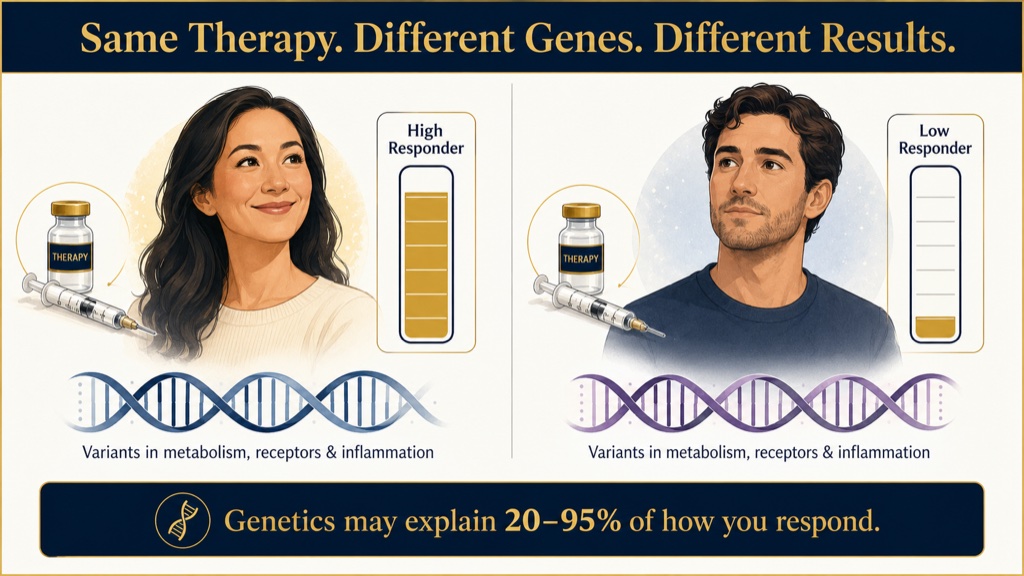
Your genome gets a vote. Inherited differences in how you metabolize, signal, and clear inflammation can explain anywhere from 20% to 95% of the variation in response, which is why a personalized plan beats a one-size-fits-all protocol.
This logic applies with special force to peptides, precisely because they act through receptors and pathways that are themselves genetically variable — the same BPC-157 growth-hormone-receptor pathway, for instance, will not be identically expressed in every person. As the genomics-diagnostics firm The Genomics Company argues, mapping an individual's relevant variants is a prerequisite for predicting who will respond to which molecule, and at what dose.[23] That genetic layer is the bedrock of what we call the Digital Twin for Predictive Peptide Performance™: you cannot personalize a protocol you have not first measured.
The intelligence layer: from guesswork to a testable hypothesis
If genomics tells you who you are, artificial intelligence is now telling clinicians which cells and which signals will actually work — and this is the frontier that separates a 2026 conversation from a 2016 one.
The perennial problem with cell therapy has been consistency: biological heterogeneity, inconsistent behavior, and unpredictable potency.[24] Machine learning attacks exactly those failure points. A 2025 review by Mengyu Huang and colleagues at the University of Hong Kong details how AI can predict an MSC batch's differentiation capacity, immunomodulatory function, and therapeutic potential from multi-omics and imaging data — and how deep-learning models trained on nothing more than the shape of a cell under the microscope can forecast how it will behave.[25] A 2024 analysis in the European Journal of Pharmacology reached the same conclusion: AI meaningfully improves the characterization and potency prediction of cell products such as MSCs.[26] Regulators are moving with it, not against it: a 2026 review notes that the FDA's 2025 draft guidance explicitly contemplates digital-twin-enabled process optimization and predictive release testing as legitimate development tools.[27] When the regulator writes "digital twin" into its guidance, the concept has left marketing and entered medicine.
Stack these layers, and the architecture comes into focus. A sensor layer — wearables, labs, imaging, body-composition scans — captures multi-modal health data. An intelligence layer fuses that data with the individual's genomic profile into a personalized model. And predictive modeling turns that model into specific, testable recommendations.
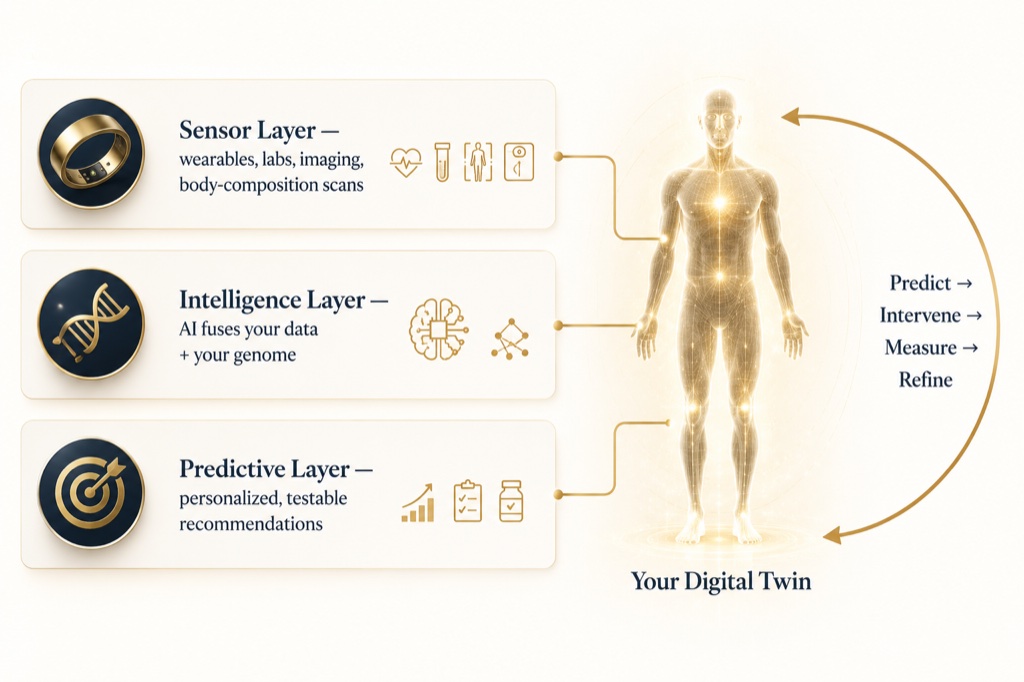
A digital twin stacks three layers — sensors that measure you, AI that models you, and predictions you can test — then closes the loop: predict, intervene, measure, refine.
Consider how that plays out in a composite case (illustrative, not a real patient): a 52-year-old former collegiate rower, now a founder, with grade-2 knee osteoarthritis, mild rotator-cuff tendinopathy, and the early muscle loss that a decade of 60-hour weeks quietly produces. The old approach offered him a generic injection and a shrug. The digital-twin approach runs differently. His genomic panel flags variants in inflammatory-signaling and metabolic genes that predict how he clears inflammation and responds to regenerative signaling.[22][23] His sensor layer sets objective baselines: joint-space width and cartilage lesion volume on imaging, muscle quality on a body composition scan, and recovery and sleep from wearables. The intelligence layer models these together to estimate his probable response and to set the dose within the evidence-supported range — recalling that roughly 40 million cells mark the practical threshold for his grade of knee OA.[10] Any adjunctive peptide is chosen against his genotype rather than a generic template.
The twin does not guarantee an outcome. It replaces a single expensive guess with a measured hypothesis you can track: cartilage volume either moves or it doesn't, and the model learns either way. That feedback loop — predict, intervene, measure, refine — is the entire difference between longevity planning and longevity shopping.
The fine line: restore, don't enhance
For any competitive athlete — and for the executive who still races triathlons on weekends — the regulatory boundary is subtle and widely misunderstood. The popular claim that "stem cells are allowed in sport" is only half true.
The World Anti-Doping Agency's position is precise: non-transformed stem cells used on their own, with no growth factors or hormones added, are permitted to heal an injury as long as they return the affected area to normal function and do not enhance it beyond baseline.[28] The instant the preparation is modified to be performance-enhancing, or a prohibited substance is added, it becomes a banned method; cell and gene doping sit under Article M3 of the Prohibited List and can carry a four-year first-offense suspension.[29] The U.S. Anti-Doping Agency adds a practical warning: even commercially sold, donor-derived products can trigger a violation if a prohibited substance was added, and any such product legally must also be FDA-approved. [30]
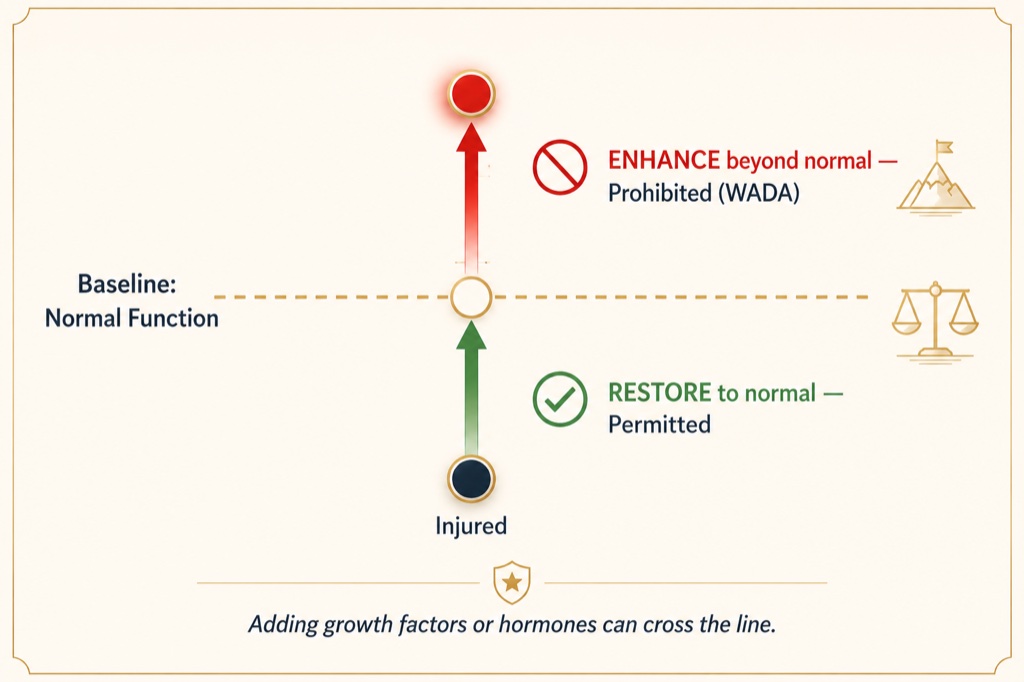
The entire regulatory principle in one picture: unmodified stem cells that bring you back to normal function are permitted, but anything engineered to push you above baseline — or spiked with added hormones — is banned.
The clearest illustration is another baseball-famous comeback. In 2010, the 37-year-old pitcher Bartolo Colón — his career seemingly over from a torn rotator cuff and elbow ligament damage — received an injection of his own fat- and marrow-derived cells and returned to pitch in the majors until he was 45.[31] The ensuing controversy, tellingly, was never about the stem cells; it was about whether growth hormone had been added to the mix (his physicians said it had not).[32] That is the whole principle in one anecdote: the cells that restore you are treated very differently from anything designed to make you superhuman. For the compliant athlete, what gets added to the syringe matters more than the cells themselves — and the answer belongs in writing before the needle goes in.
The translators: the coaches and practitioners who turn data into plans
None of this — not the genomics, not the imaging, not the AI — matters to a human being until someone can translate it into a plan they will actually follow. That translation is a genuine expertise, and it belongs to a profession that longevity science too often overlooks: the performance coaches, dietitians, nutritionists, weight-loss and executive coaches, and the science-literate influencers who have become many people's most trusted health advisors.
These practitioners are, increasingly, the front line of preventive medicine. They are the ones who notice when a client's recovery has stalled, who understand why muscle quality matters more than a number on a scale, who can explain why a peptide derived from the body's own proteins is a different proposition from a random supplement, and who hold clients accountable long after a clinic visit is forgotten. Their edge is scientific literacy — and that edge is exactly what LongevityPlan.AI is built to sharpen. A Coach / Practitioner armed with a client's genomic profile, objective baselines, and AI-powered coaching improvements can do something a generic wellness plan never could: match the right intervention to the right Athlete / Patient, then prove it worked. This is the substance of a real Peptide Longevity Plan™ — not a protocol pulled from a forum, but a personalized, measured, and reversible strategy.

The most valuable person in longevity may be the coach, dietitian, or practitioner who translates the data into a plan you'll actually follow — and keeps you on it long after the clinic visit ends.
For the professional, the framework for evaluating any regenerative offering is short and non-negotiable, and it is worth committing to memory: ask exactly what is in the preparation and whether anything was added; insist on the baseline measurements and the follow-up imaging that will prove or disprove the result; confirm the dose sits in the range the literature supports; and, for any competitor, verify the protocol against the current anti-doping rules. A provider who cannot answer these in plain language is a marketing operation wearing a lab coat — and a knowledgeable coach is the client's best protection against exactly that.
The manual was always yours
Step back, and the theme that unifies this field is a hopeful one. The most powerful regenerative tools we have — medicinal signaling cells, peptides drawn from our own proteins, satellite cells waiting to be woken — are not exotic foreign compounds. They are the body's own systems. The work of the next decade is not to overpower human biology but to read it accurately and prompt it precisely.
That is why the data-first posture matters commercially as much as scientifically. The wellness market overflows with confident promises and thin evidence. The durable advantage — for a clinic, a coach, or an individual planning the second half of a long life — belongs to whoever treats the body as a measurable system and the intervention as a testable hypothesis.
Jack Nicklaus got a gradual, unmeasured result in 2016 and, well into his seventies, kept teeing it up at the game he loves. The version available now is not luck. It is a genome, a baseline, a model, and a follow-up scan — available to anyone willing to plan for their longevity before the injury rather than after. Golf, as the Golden Bear said, is a game of a lifetime. So, increasingly, is the science of extending one. The repair kit was always yours. The new part is that, for the first time, we can read the manual.

The most powerful tools we have aren't foreign compounds — they're the body's own systems. The new frontier isn't overpowering biology; it's reading it accurately and prompting it precisely.
Sign up for FREE daily Longevity Club Workshops, or join the Affiliate Program (pays 20%). Subscribe to the Longevity & Peptide Optimization Newsletter.
About the Author
Tony Medrano is CEO and co-founder of LongevityPlan.AI, a platform that integrates performance and health data and leverages proprietary Digital Twin for Predictive Peptide Performance™ technology, wearable data, and biomarker data to deliver personalized optimization and longevity recommendations. A 3x technology/AI company CEO with 2 successful exits, Tony has completed 3 Full Ironman Triathlons (140.6 mi) since 2019. He holds degrees from Harvard University, Columbia University, and a JD/MBA from Stanford University, and has worked with the US Olympic Team, the NBA, NFL, MLB, NASA, Google, Microsoft, and Netflix, among others. He also served as a US Navy Officer commanding an emergency response team aboard a destroyer.
Disclaimer: This article is educational and is not medical advice. Stem cell therapies discussed here are largely investigational and are not FDA-approved for orthopedic or longevity indications, and BPC-157 and TB-500 are not FDA-approved and are prohibited in tested sport. Nothing here recommends a specific therapy. Decisions of this kind require a qualified clinician and current laboratory data.
Endnotes and sources
- Golf Digest, "Jack Nicklaus Reveals His Secret, Experimental Stem Cell Therapy in CNN Interview" (April 27, 2018); golf.com, "Jack Nicklaus Opens Up About Receiving Stem Cell Therapy for His Back Pain" (2018). Procedure by Dr. Eckhard Alt, Munich, February 2016: abdominal liposuction, ~3 oz of fat, cells injected into 14 spinal/neck sites.
- New Scientist, "Golfer Jack Nicklaus Says Stem Cell Therapy Cured His Back Pain" (April 2018), reporting his remarks at the Unite to Cure conference, Vatican City ("I decided to give stem cells a go").
- golf.com (2018): Nicklaus, "Golf is a game of a lifetime"; and CNN/Golf Digest (2018): his prediction that stem cells will "change... the direction of orthopedics."
- Caplan AI. "Mesenchymal Stem Cells: Time to Change the Name!" Stem Cells Translational Medicine, 2017. DOI: 10.1002/sctm.17-0051. Origin of the term and the proposed rename to "medicinal signaling cells."
- "Body Management: Mesenchymal Stem Cells Control the Internal Regenerator," PMC4479626, and reviews of MSC secretome/exosome ("acellular") therapy — on the paracrine/immunomodulatory signaling mechanism.
- Gobbi A, Acosta M, Salvador AJ, et al. "Mesenchymal Stem Cells (MSCs) — from Arnold Caplan to Present," Journal of Orthopedics and Muscular System (2026 review): MSCs comprise ~0.001–0.01% of bone-marrow aspirate concentrate; RoosterBio educational materials on MSC-manufacturing standardization.
- Comparative data on ADSC vs BM-MSC advantages (lower morbidity, higher yield, angiogenic potential): Int. J. Mol. Sci. 26(17):8476 (2025); Jo et al. 2014 (below).
- Jo CH, Lee YG, Shin WH, et al. "Intra-Articular Injection of Mesenchymal Stem Cells for the Treatment of Osteoarthritis of the Knee: A Proof-of-Concept Clinical Trial." Stem Cells 32(5):1254–1266, 2014. DOI: 10.1002/stem.1634.
- "Cartilage Regeneration Potential in Early Osteoarthritis of the Knee: ADSC Therapy vs Hyaluronic Acid." Int. J. Mol. Sci. 26(17):8476, 2025. Medial femoral cartilage lesion volume: −50.06 mm³ (ADSC) vs +36.44 mm³ (HA); superior WOMAC outcomes; no serious adverse events.
- "Intraarticular Injection of Bone Marrow-Derived Mesenchymal Stem Cells Enhances Regeneration in Knee Osteoarthritis," PMC7669782: ~40 × 10⁶ cells identified as likely optimal for grade ≥2 knee OA; notes methodological heterogeneity.
- "Mesenchymal Stem Cells for Treatment of Tendon and Ligament Injuries — Clinical Evidence," PMC7780758: roughly half of sports injuries involve tendon; poor vascularity slows healing.
- Koshy D, Koshy DI, Ooi E. "Biologic Therapies in the Management of Sports-Related Tendon and Ligament Injuries: A Narrative Review." Cureus 17(5):e84556, 2025. DOI: 10.7759/cureus.84556.
- Lu V, Tennyson M, Zhang J, Khan W. "Mesenchymal Stem Cell-Derived Extracellular Vesicles in Tendon and Ligament Repair — A Systematic Review of In Vivo Studies." Cells 10(10):2553, 2021. DOI: 10.3390/cells10102553 (11 of 383 studies met criteria; all reported improved repair).
- Hernigou P, et al. "Biologic augmentation of rotator cuff repair with mesenchymal stem cells during arthroscopy improves healing and prevents further tears: a case-controlled study." Int Orthop 38:1811–8, 2014. DOI: 10.1007/s00264-014-2391-1. Rotator-cuff tears affect ~20% of the population (per NCT03362424 background).
- Springer, "Adipose-derived stem cell-based optimization strategies for musculoskeletal regeneration," Stem Cell Res Ther, 2024, DOI: 10.1186/s13287-024-03703-6; Forcales S-V, Front. Aging Neurosci. 7:123, 2015 (satellite-cell biology and M2 macrophage polarization).
- Schilling BK, et al. "Adipose-derived stem cells delay muscle atrophy after peripheral nerve injury in the rodent model." Muscle & Nerve 59(5):603–610, 2019 (McGowan Institute, Univ. of Pittsburgh): preserved muscle mass, larger fiber area, less lipid.
- Sikiric P, et al. "Stable Gastric Pentadecapeptide BPC 157" reviews, incl. Frontiers in Pharmacology (2021) and Pharmaceuticals (Basel) (2025): BPC-157 as a 15-amino-acid partial sequence of "body protection compound" from human gastric juice, modulating angiogenesis via the nitric-oxide system.
- Staresinic M, Sikiric P, et al. "Gastric pentadecapeptide BPC 157 accelerates healing of transected rat Achilles tendon." J Orthop Res, 2003. DOI: 10.1016/S0736-0266(03)00110-4: increased load to failure and Young's modulus; superior fibroblast/collagen formation; restored tendon integrity.
- Chang CH, Tsai WC, Lin MS, et al. "The promoting effect of pentadecapeptide BPC 157 on tendon healing involves tendon outgrowth, cell survival, and cell migration." J Appl Physiol, 2011. DOI: 10.1152/japplphysiol.00945.2010 (FAK-paxillin pathway; dose-dependent fibroblast migration; survival under oxidative stress).
- Chang CH, et al. "Pentadecapeptide BPC 157 Enhances the Growth Hormone Receptor Expression in Tendon Fibroblasts." PMC6271067 (2014).
- Vasireddi N, Hahamyan HA, Salata MJ, et al. Systematic review of BPC-157, HSS Journal (2025): 36 studies (1993–2024), 35 preclinical animal studies and 1 uncontrolled human chart review; no completed controlled human efficacy trials reported; plasma half-life under 30 minutes.
- Estimate that genetic factors may explain 20–95% of variability in individual drug response: Kalow W, et al., as cited in "Pharmacomicrobiomics: a novel route towards personalized medicine?" PMC5960471; see also "Pharmacogenomics: Driving Personalized Medicine," ScienceDirect, 2025.
- The Genomics Company (thegenomicscompany.com) — genomic assessment of individual variants relevant to therapeutic (including peptide) response; consistent with the pharmacogenomic principles in Endnote 22.
- Choudhery MS, Arif T, Mahmood R. "Applications of artificial intelligence in stem cell therapy." World J Stem Cells, 2025 (heterogeneity, consistency, and safety challenges AI aims to address).
- Huang M, Dissanayaka WL, Yiu CKY. "Artificial Intelligence Driven Innovation: Advancing Mesenchymal Stem Cell Therapies and Intelligent Biomaterials for Regenerative Medicine." Bioengineering 12(12):1302, 2025. DOI: 10.3390/bioengineering12121302.
- Sarabi PA, Shabanpouremam M, Eghtedari AR, et al. "AI-Based solutions for current challenges in regenerative medicine." Eur J Pharmacol 984:177067, 2024. DOI: 10.1016/j.ejphar.2024.177067 (Royan Institute).
- "Artificial Intelligence and the Transformation of Cell and Gene Therapy Development," PMC13029694 (2026): references the FDA's 2025 draft guidance contemplating digital-twin-enabled process optimization and predictive release testing.
- World Anti-Doping Agency, The Prohibited List (2025): non-transformed stem cells used alone, without added growth factors or hormones, are not prohibited when they restore normal function and do not enhance it.
- WADA 2026 Prohibited List; Athletics Integrity Unit & UK Anti-Doping summaries: cell and gene doping fall under Article M3; non-specified methods can carry up to a four-year first-offense sanction.
- USADA, "What Do Athletes Need to Know About Stem Cell Therapies" (updated 2025): prohibited if modified to be performance-enhancing or if prohibited substances are added; donor-derived commercial products must be FDA-approved and may still be prohibited. See also the AMSSM Position Statement (Finnoff JT, et al., Clin J Sport Med).
- CBS New York and PopSci (May 2011); PUR-FORM (2025), summarizing Bartolo Colón's April 2010 adipose- and marrow-derived cell procedure (Dr. Joseph Purita); originally reported by The New York Times.
- CBS New York, "Doctor Defends Stem Cell Procedure on Yankees' Bartolo Colón" (May 2011): Colón's physician stated no human growth hormone was used; HGH is banned by MLB.