Environmental Health
·15 min read
Invisible Estrogen Effects and Dangers: Mold, Metals, and Your Tap Water
A skeptic's guide to the hormone-mimicking compounds hiding in everyday life, why your genes decide how much of it sticks, and how measurement, not panic, turns exposure into a plan.
By Tony Medrano, CEO & Founder, LongevityPlan.AI
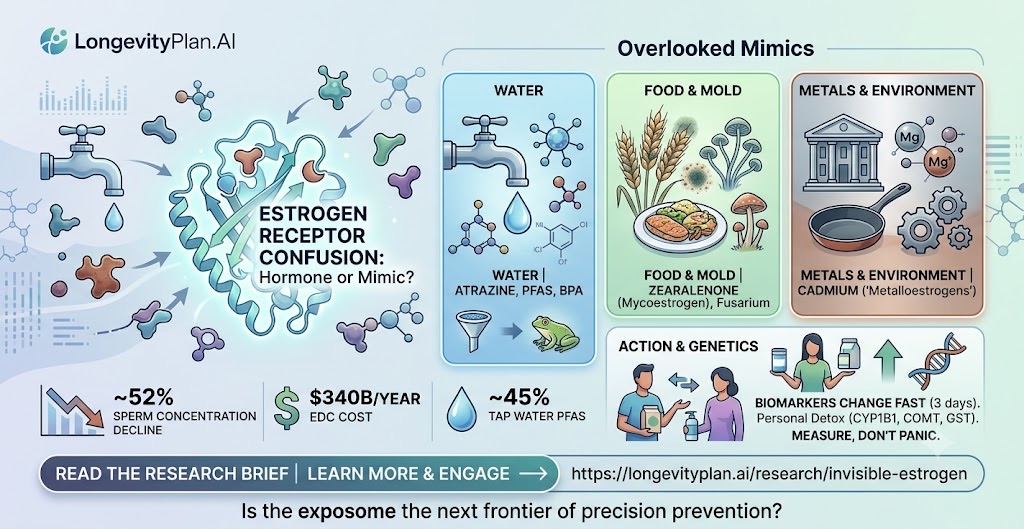
Here is an uncomfortable thing to learn before lunch: your body cannot reliably tell the difference between the estrogen your own ovaries or adrenal glands make and a molecule that drifted in from a cornfield, a frying pan, or a water-damaged ceiling tile. The hormone receptor is a lock. Estrogen is the key it was built for. The problem is that a surprising number of industrial and fungal molecules are shaped just enough like that key to turn the lock — and a few of them turn it at concentrations measured in parts per billion.

Hormone receptors evolved to recognize the body's own estrogen (17β-estradiol). Many synthetic molecules, like the plastics chemical Bisphenol A (BPA), share just enough of that shape to fit the same lock — the molecular reason "xenoestrogens" can hijack hormonal signaling.
This is not a fringe idea or a wellness-influencer talking point. It is the consensus position of the Endocrine Society, the largest organization of hormone scientists and clinicians in the world, whose two scientific statements on endocrine-disrupting chemicals (EDCs) describe a body of evidence that has only thickened since. And it is increasingly a question of money and performance, not just biology. So before we get to mold, metals, and water — the three exposures this brief is actually about — let's establish why a high-functioning, data-literate adult should care at all.
Why a skeptic should keep reading
In a 2016 analysis published in The Lancet Diabetes & Endocrinology, a team led by NYU pediatrician and environmental-health researcher Leonardo Trasande estimated that exposure to endocrine-disrupting chemicals costs the United States roughly $340 billion a year — about 2.33% of GDP — in disease and lost productivity, nearly double the burden in the more tightly regulated European Union. Trasande's framing is blunt and worth keeping in mind as a thesis statement for everything below:
"Policy predicts exposure, exposure predicts disease and disease ultimately costs our economy."
Mount Sinai reproductive epidemiologist Shanna Swan, whose meta-analyses are among the most-cited in the field, documented that average sperm concentration in Western men fell from about 99 million per milliliter in 1973 to roughly 47 million per milliliter by 2011 — a decline of about 52% in under four decades, accelerating after the year 2000. Swan attributes a meaningful share of that trend to anti-androgenic and estrogenic chemicals, particularly phthalates, and does not hedge about the stakes, describing a world that is, in her words, "in a fertility crisis" driven by synthetic chemistry. You can argue about the magnitude — obesity, age at first child, and lifestyle all contribute — but the curve is real, it is global, and it is moving in one direction.
And here is the part that breaks classical toxicology's intuition. We were all taught "the dose makes the poison": more exposure, more harm. Hormone-mimicking chemicals don't always obey that rule. Because they work through receptors that the body deliberately keeps exquisitely sensitive, EDCs can produce effects at very low doses that vanish or even reverse at higher ones — so-called non-monotonic dose-response curves. As University of Massachusetts endocrinologist Thomas Zoeller has explained on behalf of the Endocrine Society, hormones rarely show simple dose linearity, which means a regulatory test that only looks at high doses can sail right past a real low-dose effect. This is why the comforting phrase "it's below the safety threshold" deserves a raised eyebrow when the molecule in question is an estrogen mimic.
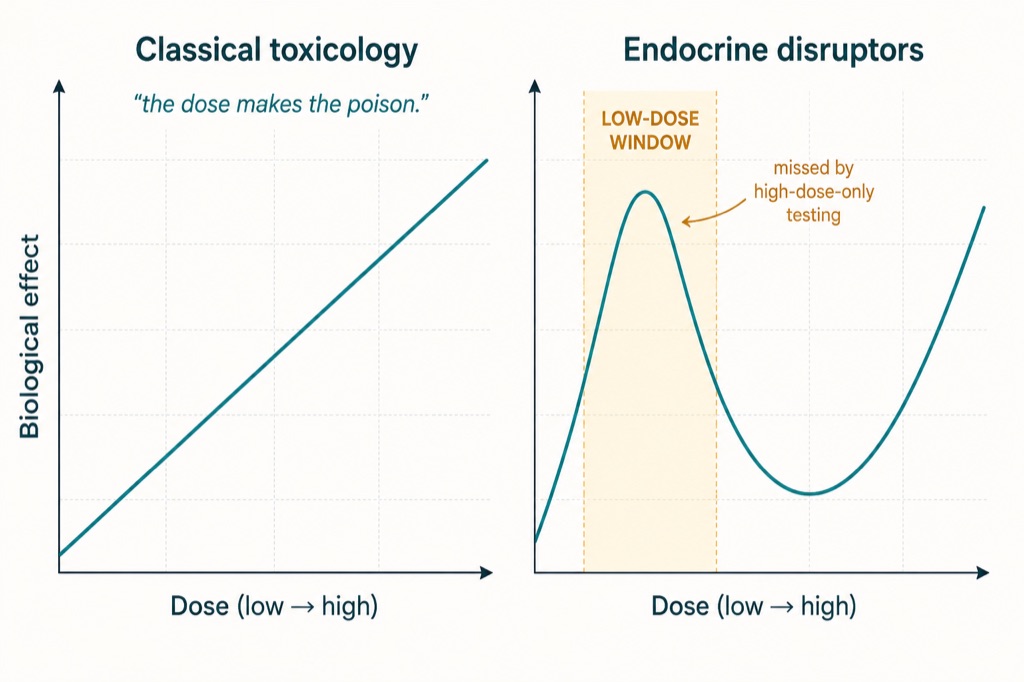
Classical toxicology assumes effects rise steadily with dose. Hormone-mimicking chemicals often don't — they can produce real effects at very low doses that standard high-dose safety tests sail right past.
None of this calls for fear. It calls for the same thing every other domain of longevity planning calls for: measurement, personalization, and a few high-leverage changes. Let's walk through the three exposures.
Pillar 1: Water — the exposure you can actually control
Of the three sources in this brief, drinking water is the one where a motivated person can move the needle fastest, because the intervention is a device you can buy, and the result is a number you can re-test. It is also where the science of estrogenic contamination is most vivid.
The frog that changed the conversation
In a now-famous line of work, UC Berkeley integrative biologist Tyrone Hayes showed that atrazine — one of the most heavily applied herbicides in the world, with roughly 80 million pounds used annually in the United States — feminizes male amphibians. In a 2010 PNAS study, male African clawed frogs raised in atrazine-laced water were chemically castrated, and a subset were so completely feminized that they mated with unexposed males and laid viable eggs. The effects appeared at 2.5 parts per billion, below the level the EPA permits in drinking water, and earlier work found gonadal abnormalities at 0.1 ppb — thirty times below the drinking-water limit. Berkeley's own summary noted the broader point: atrazine is "the most common pesticide contaminant of ground and surface water."
Frogs are not people, and a responsible reader should hold the cross-species leap loosely. But the demonstration that an estrogen-active compound, at concentrations the regulatory system considers acceptable, can rewrite the sexual development of a vertebrate is exactly the kind of result that should make us curious about what is in our own glass.
The "forever chemicals" problem
The contaminant class drawing the most attention today is PFAS — per- and polyfluoroalkyl substances, the "forever chemicals" engineered into nonstick coatings and stain repellents by manufacturers including DuPont (Teflon) and 3M (Scotchgard). PFAS resist breakdown, accumulate in blood and liver for years, and have been detected in roughly 98–99% of Americans tested. The Environmental Working Group estimates that more than 200 million Americans may have PFAS in their tap water above 1 part per trillion, and federal scientists estimate at least 45% of U.S. tap water contains one or more PFAS. Beyond their links to certain cancers and immune suppression, several PFAS are documented endocrine disruptors with thyroid and developmental effects.
Add the better-known plastic chemical bisphenol-A — which EWG describes plainly as "a synthetic estrogen" — and the pharmaceutical estrogens and estrogen metabolites that pass through wastewater treatment, and the picture is of a low-grade, chronic, mixed estrogenic signal coming through the kitchen faucet. Harvard exposure scientist Joseph Allen has captured the structural reason Americans bear more of this than Europeans do: by his account, people in the U.S. carry more industrial chemicals in their bodies than their European counterparts, largely because of differences in chemical policy, not lifestyle.
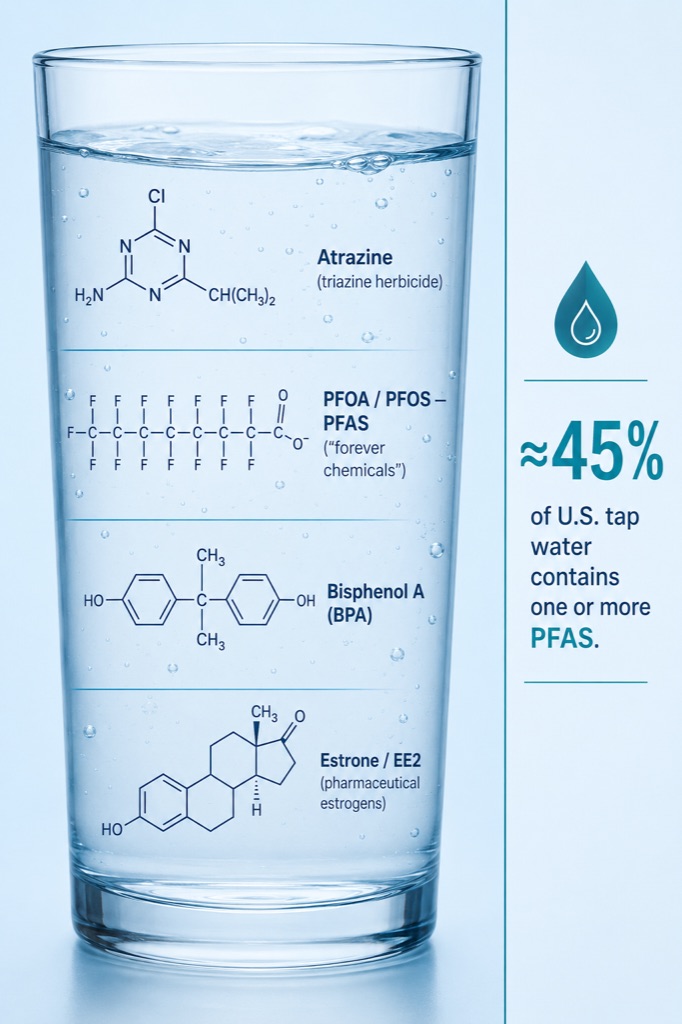
A single glass can carry a low-grade mix of estrogen-active compounds — herbicides like atrazine, "forever chemicals" (PFAS), plastics residue (BPA), and pharmaceutical estrogens that survive wastewater treatment. Of the three exposure sources in this brief, water is the one you can most easily test and fix.
What the data says to do about it
This is the encouraging part. Water is fixable. EWG's testing and the broader point-of-use literature converge on a simple hierarchy: reverse osmosis and high-quality activated carbon filtration are the most effective household methods for reducing PFAS and many other contaminants. The practical sequence for a skeptic is: (1) look up your ZIP code in EWG's Tap Water Database to see what has actually been reported in your supply; (2) if you are on a private well or want certainty, test; (3) match a filter — certified by NSF International, the independent standards body — to the specific contaminants you have, rather than buying on marketing claims. The longevity-relevant insight is that filtration is one of the rare interventions where you can verify the result with a follow-up test, which is precisely how a measurement-driven plan should work.
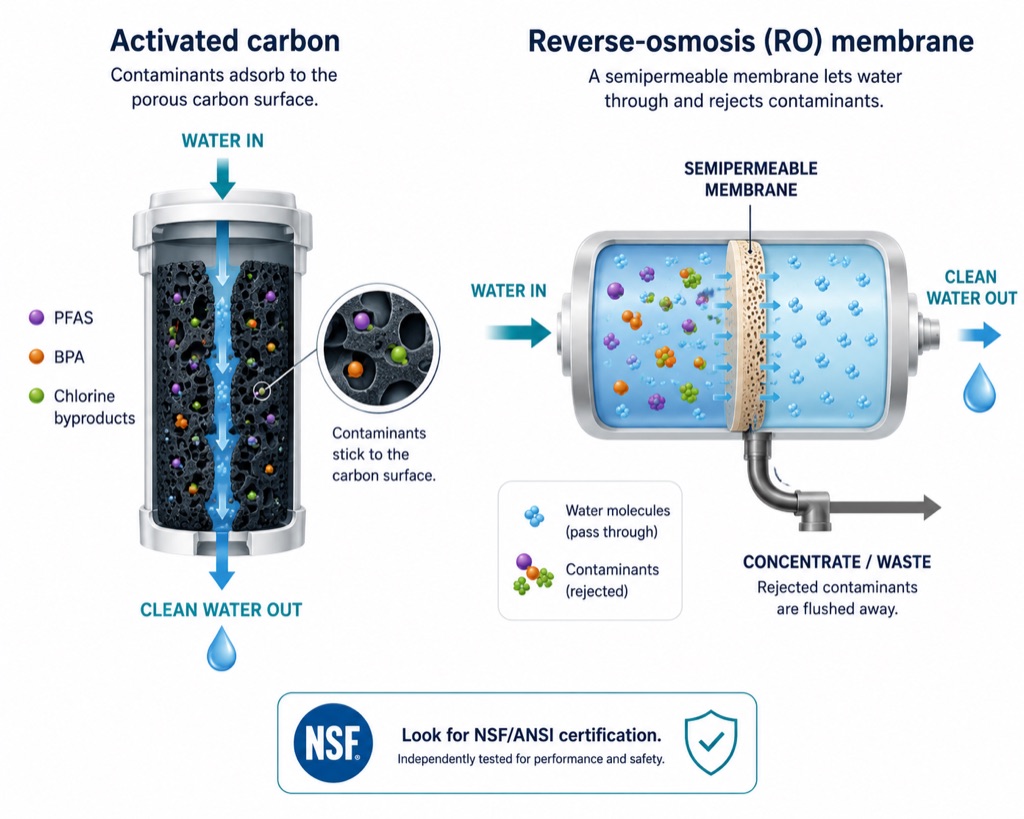
The two most effective household defenses against PFAS and many estrogenic contaminants. Activated carbon adsorbs chemicals onto its surface; reverse osmosis physically blocks them at a membrane. Match the filter to your specific contaminants — and re-test to confirm it worked.
Pillar 2: Mold — the estrogen you didn't know your pantry was making
Most people file "mold" under allergies and musty smells. Fewer know that certain molds are tiny estrogen factories. The clearest example is zearalenone (ZEN), a mycotoxin produced by Fusarium fungi that commonly colonize corn, wheat, barley, and other grains in the field and in storage.
Zearalenone is so structurally similar to 17β-estradiol that it binds both estrogen receptors and acts as a mycoestrogen — a fungal xenoestrogen. Its estrogenic potency is well documented in livestock, where it causes a recognizable hyperestrogenic syndrome in pigs, and its derivatives were historically developed as cattle growth promoters (a use the European Union has banned). In humans, the evidence is more circumstantial, but ZEN exposure has been associated with menstrual irregularities and precocious puberty, and ZEN is classified as an endocrine disruptor by toxicology references. A 2017 study added a wrinkle that matters for real-world exposure: when ZEN, its metabolite α-zearalenol, and the Alternaria toxin alternariol were combined, most pairings produced synergistic estrogenic effects — the mixture was more potent than the sum of its parts, even at very low concentrations. Real diets and real buildings deliver mixtures, not single chemicals, which is exactly why simple "safe level" reasoning struggles here.

Certain molds aren't just an allergy problem — they're tiny estrogen factories. Fusarium fungi on stored grains produce zearalenone, a "mycoestrogen" shaped enough like your own estrogen to bind the same receptor. Proper food storage and indoor-moisture control are the front-line defenses.
The practical takeaways are unglamorous and effective. Mycotoxins concentrate in improperly stored grains, certain coffee and corn products, and water-damaged buildings. Storing dry goods well, buying from suppliers who test for mycotoxins, addressing indoor moisture and water damage promptly, and — for those who want data — using urinary mycotoxin panels to check whether ZEN and its relatives are showing up in your body are all reasonable, low-cost moves. The point is not to fear your kitchen; it is to recognize that "estrogenic exposure" includes a biological source most clean-eating protocols never mention.
Pillar 3: Heavy metals — the "metalloestrogens"
The third source is the most chemically surprising. Certain metals and metalloids — most prominently cadmium, and to varying and debated degrees nickel, arsenic, aluminum, lead, and mercury — can interact with estrogen-receptor signaling and are described in the literature as metalloestrogens. The foundational laboratory observation came from Martin and colleagues around 2000, showing that cadmium could activate estrogen receptor-α, and the term "metalloestrogen" was popularized by toxicologist Philippa Darbre in 2006.
Two features make metals a distinct longevity problem from the organic chemicals above. First, their biological half-lives are measured in years to decades rather than hours — cadmium can persist in the body for a decade or longer and concentrate in tissue, while lead is stored in bone for a lifetime. They bioaccumulate; they do not flush out over a weekend. Second, the evidence base is genuinely contested, and intellectual honesty requires saying so. A careful 2012 review concluded that the strongest case for "metalloestrogen" behavior is for cadmium and nickel, while arguing that arsenic in some models actually suppresses estrogen signaling — meaning arsenic may not belong in the category at all. This is what live science looks like: a real mechanism, real human-exposure concern, and an open debate about which metals and which doses matter. The mature response is neither dismissal nor alarm, but measurement — heavy-metal panels are inexpensive, well-validated, and actionable, because the main exposure routes (certain seafood, contaminated water, old plumbing, some cosmetics and supplements, tobacco smoke) are largely modifiable.
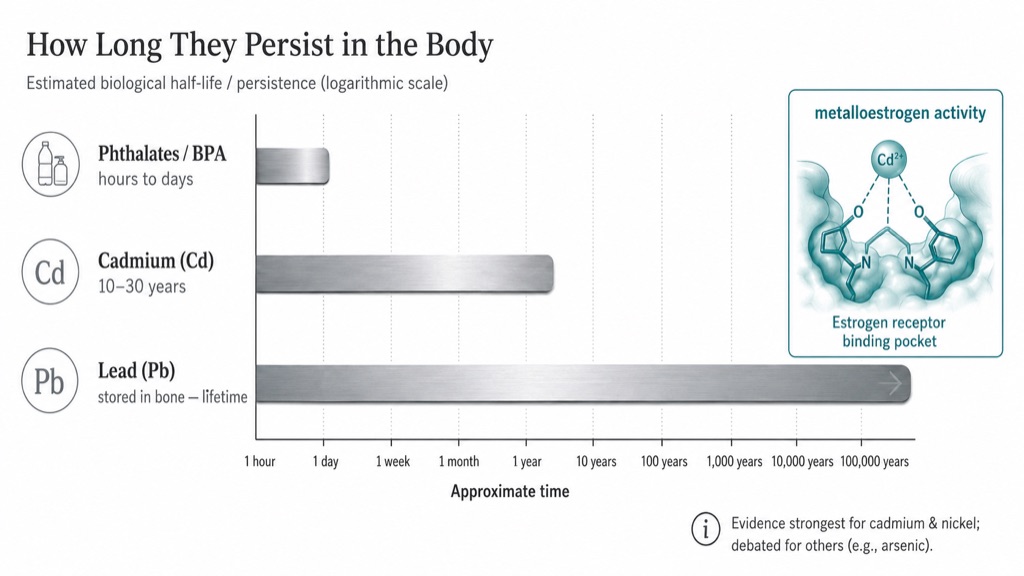
Unlike plastic chemicals that clear in days, certain metals bioaccumulate for years to decades — cadmium persists 10–30 years, lead is stored in bone for life. Several behave as "metalloestrogens," though the science is still actively debated. Because the exposure routes are modifiable, periodic heavy-metal testing is a high-value, low-cost move.
The reason none of this is one-size-fits-all: your clearance genetics
Here is the question that separates a precision-medicine approach from a generic detox listicle: if two people drink the same water and eat the same grains, do they end up with the same internal dose? The answer is no, and the reason is genetic.
Your body neutralizes both its own estrogens and foreign estrogen mimics through a two-phase enzymatic assembly line. Phase I enzymes (cytochrome P450s such as CYP1A1 and CYP1B1) chemically modify the compound; phase II enzymes (catechol-O-methyltransferase or COMT, the glutathione-S-transferases GSTM1/GSTT1/GSTP1, sulfotransferase SULT1A1, and glucuronosyltransferase UGT1A1) attach a tag that marks it for excretion. Common inherited variants meaningfully change how fast each step runs. Some people carry a CYP1B1 variant that hydroxylates estradiol more aggressively; others carry "null" deletions of GSTM1 or GSTT1 that remove an entire detox enzyme; COMT and SULT1A1 activity varies several-fold across the population.
Crucially, these same enzymes process xenoestrogens and persistent pollutants, not just endogenous hormones. A study of European and Greenlandic Inuit populations found that detoxification-gene genotypes correlated with the xenoestrogenic activity measurable in people's blood, and that environmental chemicals like PCBs can inhibit the very COMT enzyme responsible for clearing catechol estrogens. Translation: the same exposure lands differently in different bodies. Two executives on the same business trip, drinking the same hotel water and eating the same conference catering, can carry very different chemical and hormonal burdens a month later — and the difference is partly written in their genomes.
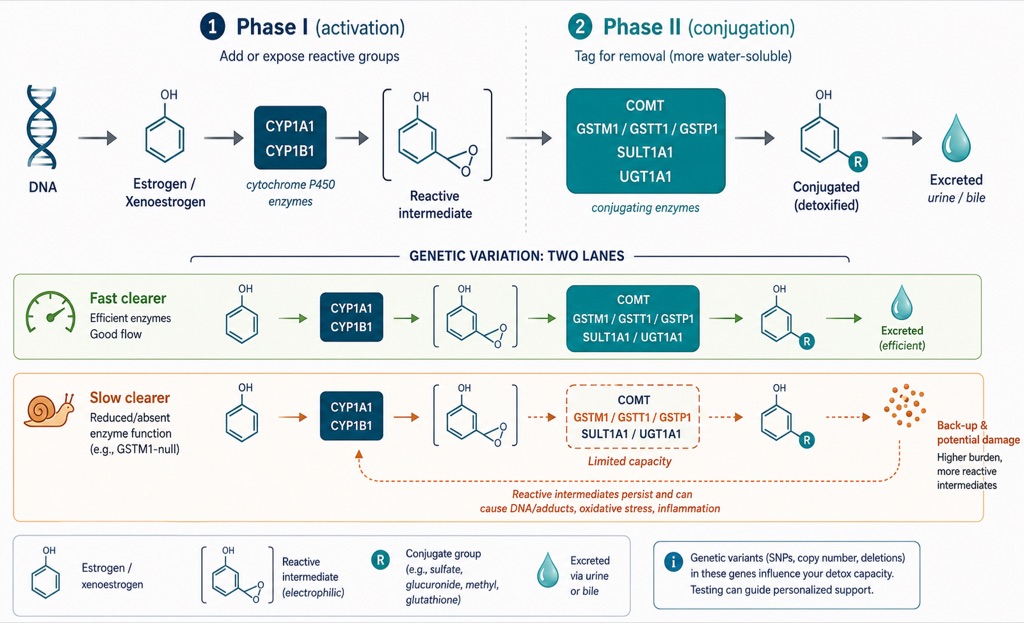
The same two-phase enzyme system clears both your own estrogen and foreign estrogen mimics. Common inherited variants (like a GSTM1 deletion) make some people far slower at the job, which is why identical exposures affect different bodies differently, and why genetics belongs at the foundation of any personalized plan.
This is the scientific foundation underneath personalized longevity planning, and it is why genomic profiling — the kind offered by specialized firms such as The Genomics Company — belongs at the base of any serious plan rather than as an afterthought. Genetics doesn't change what's in the water; it changes who needs to filter it most aggressively, who should test their metals annually rather than every few years, and who can tolerate a higher mycotoxin load before it registers. In LongevityPlan.AI's framework, that genomic layer is the foundation of the Digital Twin for Predictive Peptide Performance™ — the same individual-variation logic that determines how a person clears a xenoestrogen also helps predict how they will respond to a given therapeutic, which is why the genome is the first thing the model wants to know.
The good news, the wellness industry undersells: biomarkers move fast
If this brief has a single optimistic finding, it is this. Unlike many longevity levers that take months to register, exposure to several of these chemicals drops quickly when you remove the source — and you can prove it in your own urine.
In the HERMOSA intervention study, researchers led by Kim Harley at UC Berkeley had teenage girls switch to personal-care products labeled free of phthalates, parabens, and related chemicals for just three days. Urinary concentrations of the phthalate metabolite MEP fell about 27%, and methyl and propyl parabens fell roughly 44% and 45%. In a parallel line of work, Silent Spring Institute's Ruthann Rudel and colleagues showed that three days of a fresh-food diet with minimal packaged and canned food cut participants' bisphenol-A and DEHP (a phthalate) exposure by more than half.
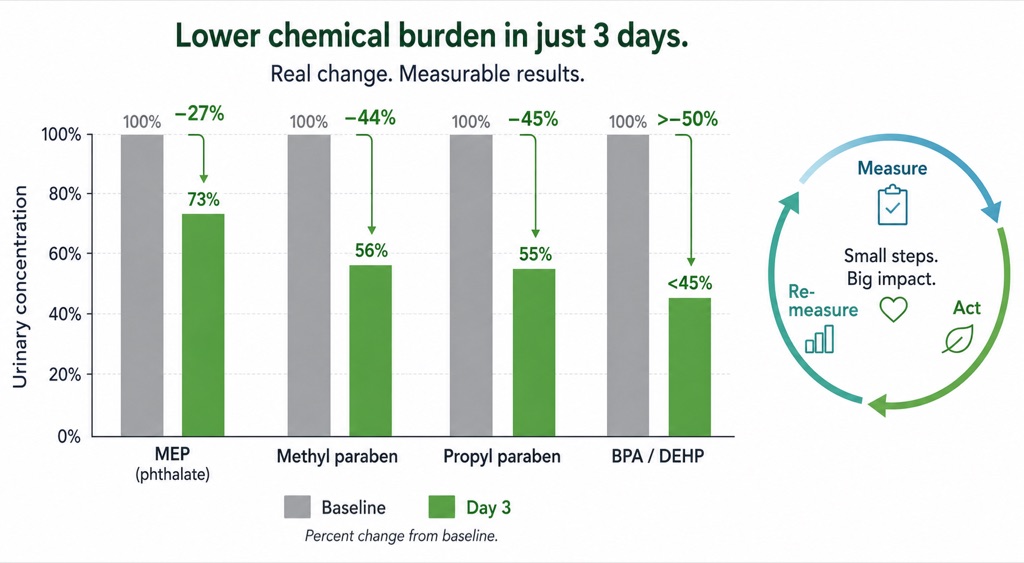
The most hopeful finding in this brief. In controlled studies, swapping personal-care products or shifting to fresh, unpackaged food cut measured phthalate and BPA levels by 27–50% in just three days. This fast feedback is what makes a "measure → act → re-measure" loop work — you can prove the change happened in your body.
Three days. This is the measurement-driven loop that defines modern precision prevention: establish a baseline with a biomarker panel, make a targeted change, and re-test to confirm the change worked in your body specifically. It is the same closed loop a serious athlete uses for lactate or a cardiologist uses for LDL — applied to your chemical exposome. The reason this matters for longevity planning is that it converts a vague anxiety ("there are chemicals everywhere") into a tractable engineering problem with a feedback signal.
A buyer's guide: how the leading players actually address this
The market for "knowing and reducing your exposure" has matured from advocacy pamphlets into real products, instruments, and software. For a skeptical buyer, the useful distinction is what layer of the problem each player solves — detect, remove, or interpret.
| Layer | What it does | Representative players |
|---|---|---|
| Detect (environment) | Tell you what's in your water, dust, or air | EWG Tap Water Database (free, ZIP-code level); Cyclopure mail-in PFAS test kits; 120Water (testing logistics and data); Consumer Reports (independent product testing) |
| Detect (body) | Measure what's actually inside you | Silent Spring Institute's Detox Me Action Kit (urinary panel for 10 EDCs); clinical heavy-metal and mycotoxin panels run on mass-spec platforms from instrument makers such as Thermo Fisher; reference labs, including Quest Diagnostics |
| Remove | Take the contaminant out of the water | Cyclopure (DEXSORB); reverse-osmosis and activated-carbon systems certified by NSF International; BlueConduit (ML to locate lead service lines); Aclarity (electrochemical PFAS destruction) |
| Interpret & personalize | Turn panels + genetics into a plan | Genomic and longevity platforms — e.g., The Genomics Company, Function Health, Superpower, Lifeforce — and AI longevity planning that fuses the layers |
Three innovators deserve a closer look because they show how far the field has moved from "avoid plastic" hand-waving toward engineered solutions.
Cyclopure spun out of the Northwestern University chemistry lab of William Dichtel, who engineered a cyclodextrin polymer — built from rings of corn-derived sugar molecules less than a nanometer across — with selective, high affinity for PFAS at parts-per-trillion concentrations. The resulting adsorbent, DEXSORB, is certified under NSF/ANSI 61 as safe for drinking-water treatment, can capture the PFAS on the EPA's roadmap, and — unlike single-use activated carbon — can be regenerated and concentrate captured PFAS for destruction, shrinking waste volume dramatically. The company also sells a consumer mail-in kit that screens a water sample for 55 PFAS compounds and returns a report benchmarked against state limits. It is a clean illustration of academic chemistry becoming a household product.
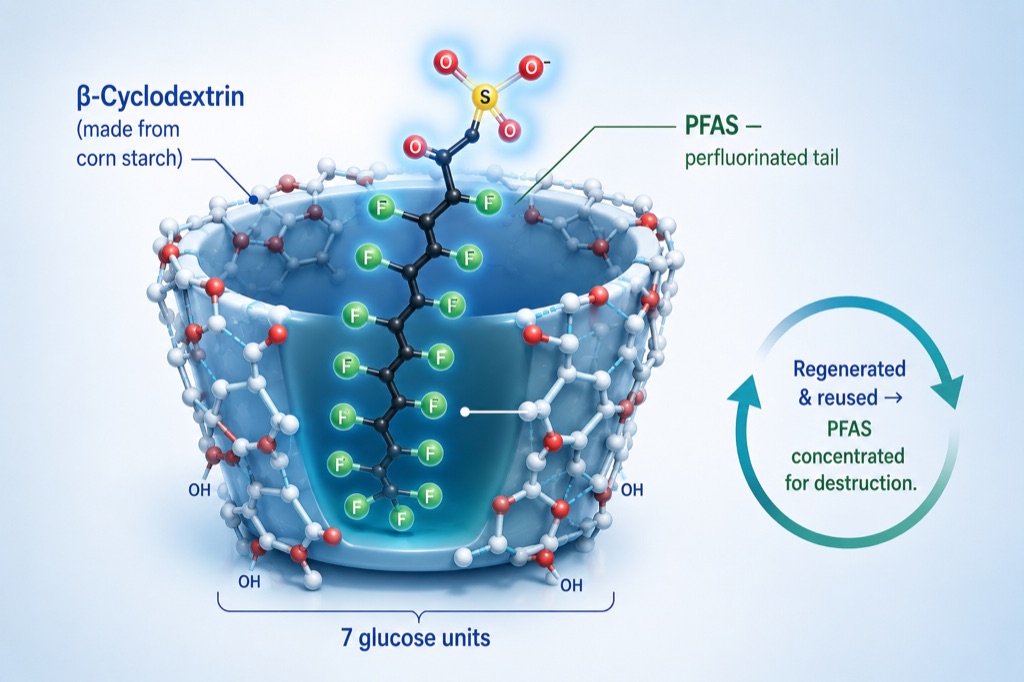
Engineered chemistry replacing hand-waving. Cyclopure's DEXSORB — a cup-shaped sugar molecule built from corn starch — selectively traps PFAS at parts-per-trillion levels, then releases them for concentrated destruction. It's NSF-certified for drinking water and a model for how lab science becomes a consumer product.
Silent Spring Institute, a research nonprofit, turned biomonitoring into a participatory tool with its Detox Me Action Kit — a simple at-home urine test for ten common endocrine disruptors — and a companion app distilling two decades of exposure research into concrete swaps (for instance, a quick-drying polyester shower curtain instead of a vinyl one that off-gasses phthalates). Its motto — knowledge as "a prescription for prevention" — could be the tagline for this entire brief.
BlueConduit grew out of the data-science response to the Flint water crisis: it uses machine learning to predict which homes are still fed by lead service lines, helping utilities prioritize replacements far more efficiently than digging blindly. It is a reminder that for lead — a metalloestrogen with no safe blood level in children — the most powerful intervention is sometimes an algorithm pointed at infrastructure, not a supplement.
On the interpretation layer, the comparison among consumer longevity platforms is really a comparison of breadth versus depth. Broad-panel testing memberships (Function Health, Superpower) emphasize measuring a very large number of biomarkers, some of which assess heavy metal and toxin exposure; physician-led services (Lifeforce and newer entrants like Protocole and Extension Health) emphasize clinician interpretation and follow-up. What none of these is built to do natively — and what an AI-powered longevity plan adds — is fuse the environmental data (your water report), the internal data (your toxin and metal panels), and the genomic data (your clearance variants) into one continuously updated model. That fusion of multi-modal health data is the difference between a stack of PDFs and a plan.
From dashboards to a digital twin
Picture how this works for a real person — call her an aging endurance athlete and founder, the exact reader this brief is written for. Her plan begins at the sensor layer: a ZIP code water report and a confirmatory PFAS test; a urinary EDC and mycotoxin panel; a heavy-metal panel; and a one-time genomic read of her phase I/II clearance genes. Those streams feed an intelligence layer that knows her GSTM1-null status means she clears certain compounds slowly, flags that her well water exceeds her personal risk threshold for PFAS, and notices her zearalenone is elevated — pointing at the bulk grains in her pantry.
The model's job is predictive modeling: not just reporting today's numbers, but projecting where her burden trends if nothing changes and simulating which single intervention yields the greatest reduction. For her, the math says install reverse osmosis first, swap two personal-care products second, and re-panel in 30 days — and because of the HERMOSA and dietary-intervention data, it can predict, with reasonable confidence, roughly how far her phthalate and BPA metabolites should fall. When the follow-up panel confirms the drop, the loop closes and the twin gets smarter. This is the same architecture that LongevityPlan.AI applies to performance physiology in its Cardiorespiratory Digital Twin™ — sensors in, predictions out, results verified, model updated — now applied to the exposome. The conversation between a Coach / Practitioner and an Athlete / Patient stops being "you should probably avoid plastics" and becomes "your MEP is down 31%, your model projected 27% — here's the next move."

A stack of PDFs becomes a plan when the layers connect. By fusing your environmental data, internal biomarkers, and genomic clearance profile, an AI-driven digital twin can project where your exposure is headed, simulate the single highest-leverage fix, and verify the result with a follow-up panel — the same sensor-to-prediction architecture used for performance physiology, now applied to the exposome.
A short, evidence-based protocol
Skeptics deserve specifics, so here is a defensible starting sequence, ordered by leverage rather than by how dramatic it sounds. First, fix the water because it is controllable and verifiable: check EWG's database, test if uncertain, and install reverse osmosis or NSF-certified activated carbon filtration matched to your contaminants. Second, reduce the easy organic chemicals: minimize canned and plastic-packaged foods, never microwave food in plastic, and favor fragrance-free personal-care products — interventions shown to cut measured phthalate and BPA exposure by 27–50% within days. Third, manage mold and metals: store grains properly and fix indoor moisture; mind known metal routes such as certain seafood, old plumbing, and tobacco smoke. Fourth, measure: a baseline panel of EDCs, mycotoxins, and heavy metals, ideally alongside a one-time genomic clearance profile, so the plan is yours and not a stranger's. Fifth, retest after 30–90 days to confirm the changes worked in your body. As environmental-health veteran Philippe Grandjean has advised, even big-ticket items respond to ordinary questions — ask about flame retardants and perfluorinated compounds before you buy the next rug or sofa.
The bottom line
The story of environmental estrogens is often told as doom — sperm counts to zero, frogs switching sex, forever chemicals in everyone's blood. The data behind those headlines is real and deserves respect. But the more useful framing for a high-functioning adult is not apocalypse; it's agency. These exposures are measurable. Several of them clear quickly once you remove the source. Your genetics tell you where to aim. And the same precision-prevention philosophy that the best sports-science and clinical programs already apply to oxygen, glucose, and recovery applies cleanly to your chemical exposome.
As EWG co-founder Ken Cook reminds the public, when protections wobble, the entire premise of environmental health policy is to protect people from exactly this kind of invisible contamination. Until policy catches up — and it moves slowly — the individual advantage goes to whoever measures first, personalizes hardest, and lets the data, not the dread, write the plan. That is a project worth starting before you feel you need to.
Sign up for FREE daily Longevity Club Workshops, or join the Affiliate Program (pays 20%).
About the Author
Tony Medrano is CEO and co-founder of LongevityPlan.AI, a platform that integrates performance and health data and leverages proprietary Digital Twin for Predictive Peptide Performance™ technology, wearable data, and biomarker data to deliver personalized optimization and longevity recommendations. A 3x technology/AI company CEO with 2 successful exits, Tony has completed 3 Full Ironman Triathlons (140.6 mi) since 2019. He holds degrees from Harvard University, Columbia University, and a JD/MBA from Stanford University, and has worked with the US Olympic Team, the NBA, NFL, MLB, NASA, Google, Microsoft, and Netflix, among others. He also served as a US Navy Officer commanding an emergency response team aboard a destroyer.
Disclaimer: This article is for educational purposes and is not medical advice, diagnosis, or treatment. Hormone and detoxification decisions should be made with a qualified clinician who can interpret your individual results. Reference ranges, assays, and products are described as of publication and may change.
Endnotes
- Endocrine Society, Introduction to Endocrine Disrupting Chemicals (EDCs) and the Second Scientific Statement (Gore et al., Endocrine Reviews, 2015), incl. discussion of thresholds, low doses, and non-monotonic dose-response (Zoeller commentary).
- Attina/Trasande et al., "Exposure to endocrine-disrupting chemicals in the USA: a population-based disease burden and cost analysis," The Lancet Diabetes & Endocrinology (2016): $340B/yr, 2.33% of GDP. Trasande and Joseph Allen quotes via Reuters/CNN coverage. Grandjean quote via Common Dreams (2016).
- Levine/Swan et al. sperm-count meta-analysis; Count Down (Scribner, 2021). 99→47 million/mL; ~52% decline. Swan "fertility crisis" remarks via Health and Environment Alliance and Plastic Pollution Coalition.
- Hayes et al., "Atrazine induces complete feminization and chemical castration in male African clawed frogs," PNAS (2010); UC Berkeley research summary.
- Environmental Working Group, PFAS overview and Tap Water Database; BPA described as a synthetic estrogen; Ken Cook statement on EPA's role.
- EWG, "Getting forever chemicals out of drinking water" and "Top 3 Ways to Reduce PFAS Exposure": reverse osmosis and activated carbon most effective; ~200M Americans affected; ≥45% of U.S. tap water contains PFAS.
- "Potential Effectiveness of Point-of-Use Filtration to Address Risks to Drinking Water in the United States," Environmental Health Perspectives. PMC5731620.
- Portland Clinic of Natural Health / Rupa Health clinical overviews of zearalenone as a Fusarium-derived xenoestrogen; ScienceDirect Topics: zearalenone classified as an endocrine disrupter.
- Kowalska et al. and related reviews: ZEN binds ERα/ERβ, acts as a xenoestrogen, linked to precocious puberty and hyperestrogenic effects. PMC5869386.
- ScienceDirect Topics: ZEN's estrogenic syndrome in swine; derivatives used as cattle growth promoters; EU ban.
- Vejdovszky et al., "Synergistic estrogenic effects of Fusarium and Alternaria mycotoxins in vitro" (2017): synergism among ZEN, α-ZEL, and alternariol. PMC5316405.
- Byrne et al., "Role of Cadmium and Nickel in Estrogen Receptor Signaling and Breast Cancer: Metalloestrogens or Not?" (2013) — strongest evidence for cadmium/nickel; argues arsenic may suppress ER signaling. PMC3476837.
- Stoica/Martin et al., "Activation of estrogen receptor-α by the heavy metal cadmium," Mol Endocrinol (2000); Darbre, "Metalloestrogens," J Appl Toxicol (2006); reviews of metal half-lives and tissue accumulation.
- Reviews of estrogen-metabolism gene polymorphisms (CYP1A1, CYP1B1, COMT, GSTM1/T1/P1, SULT1A1, UGT1A1) and inter-individual variability. PubMed 18714561; PMC4436276.
- Studies on functional effects of CYP1B1 L432V, GSTM1/GSTT1 null genotypes, SULT1A1 activity variants on estrogen/xenobiotic handling. PMC3152751.
- Bonefeld-Jørgensen group: CYP1A1/CYP1B1/COMT polymorphisms vs. xenoestrogenic activity in European and Greenlandic Inuit blood; PCBs inhibit COMT-mediated clearance of catechol estrogens. Int J Circumpolar Health.
- Harley et al. (HERMOSA), "Reducing Phthalate, Paraben, and Phenol Exposure from Personal Care Products in Adolescent Girls," EHP (2016): 3-day product swap cut MEP ~27%, methyl/propyl parabens ~44–45%. PMC5047791.
- Rudel et al. (Silent Spring Institute), dietary intervention reducing BPA and DEHP by >50% over 3 days. PMC3230410.
- NIEHS Superfund Research Program profile of Cyclopure; CycloPure/Dichtel cyclodextrin (CD-PFAS / DEXSORB) chemistry, JACS (2017).
- Cyclopure: DEXSORB NSF/ANSI 61 certification, EPA PFAS Roadmap coverage, regeneration, 55-PFAS mail-in test kit. cyclopure.com; EPA SBIR.
- Silent Spring Institute, Detox Me Action Kit and Detox Me app (270 tips; "prescription for prevention"). silentspring.org.
- Additional context: National Institute of Environmental Health Sciences and U.S. EPA endocrine-disruption overviews.