Longevity
·3 min read
The VO2 Max Imperative
Why Your Oxygen Capacity is the Single Most Powerful Predictor of How Long—and How Well—You'll Live
By Tony Medrano, CEO
When Nicole Harkin, a preventive cardiologist and founder of Whole Heart Cardiology, declares that having a low VO2 max carries about the same cardiovascular risk as smoking, the conversation shifts from abstract biomarkers to life-or-death metrics that deserve your immediate attention. Yet most people—even highly successful executives, competitive athletes, and health-conscious individuals—don't know their VO2 max.
This isn't hyperbole from the wellness industry. Cardiorespiratory fitness, as measured by maximal oxygen uptake (VO2max), has been shown to be a strong and independent predictor of all-cause and disease-specific mortality.
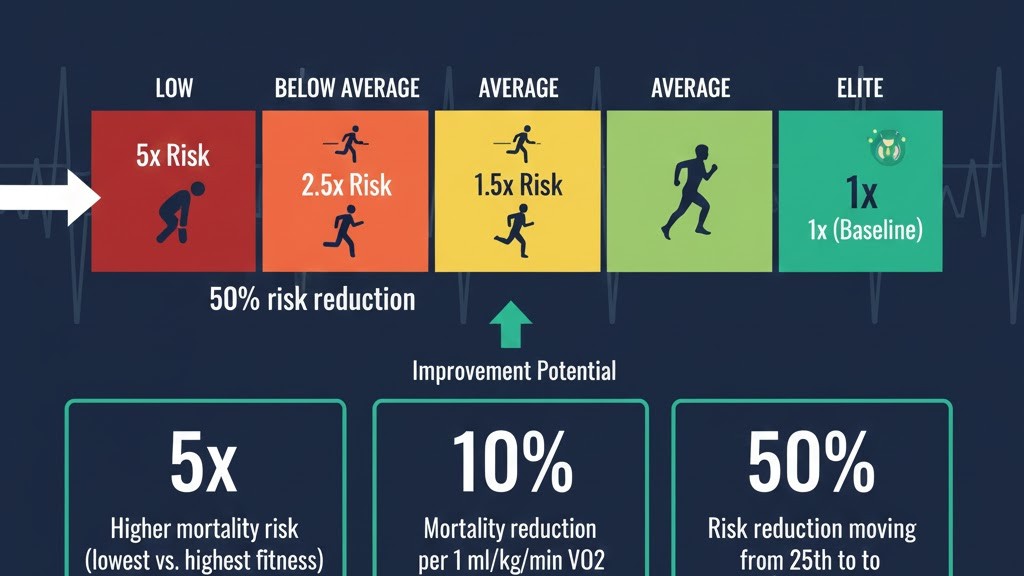
 The landmark 2018 JAMA Network Open study of 122,007 adults reveals that individuals in the lowest VO2 max quartile face nearly 5x higher mortality risk—making cardiorespiratory fitness the strongest modifiable predictor of lifespan.
The Science: Why VO2 Max Outpredicts Everything Else
VO2 max represents the maximum rate of oxygen your body can consume during intense exercise. What makes it uniquely powerful? Your fitness level, crystallized in your VO2 max measurement, is the single most predictive modifiable factor for mortality risk—better than blood pressure, cholesterol, glucose control, or body mass index.
The landmark 2018 study published in JAMA Network Open tested 122,007 adults. The Low group had a mortality rate nearly five times higher than the High group. Simply bringing your VO2 max from 'low' to 'below average' is associated with a 50% reduction in all-cause mortality, and going to 'above average' results in a 70% risk reduction. For every ml/kg/min increase from your baseline, you decrease your risk of all-cause mortality by approximately 10%.
The Oxygen Delivery System
VO2 max isn't just about your lungs or heart—it's a systems-level integration: pulmonary system (extracting oxygen from air), cardiovascular system (cardiac output), vascular network (capillary density), and cellular metabolism (mitochondrial ATP production). A limitation at any point constrains your VO2 max, which is why it serves as such a comprehensive health indicator.
Genetics vs. Lifestyle
The HERITAGE Family Study found that roughly 50% of baseline VO2 max and trainability are genetically influenced. But half-controllable means half the story. Dr. Michael Joyner of Mayo Clinic emphasizes that "all previously untrained individuals will respond to endurance exercise training provided the stimulus exceeds a certain volume and/or intensity." Even low responders still improved, and from a mortality perspective, moving from terrible to mediocre fitness provides greater risk reduction than moving from good to exceptional.
Beyond VO2 Max: Metabolic Efficiency
Dr. Iñigo San Millán, coach of Tour de France winner Tadej Pogačar, has pioneered a more nuanced understanding. VO2 max captures the ceiling of your oxygen delivery system, but doesn't tell you how efficiently you're using oxygen at submaximal intensities—where you spend 99% of your life. Zone 2 training, at a lactate concentration of 1.7-1.9 mmol/l, most effectively stimulates mitochondrial function. For Pogačar, roughly 80% of training is Zone 2, with 20% dedicated to high-intensity efforts.
The Measurement Revolution
Three technological revolutions are democratizing VO2 max: consumer wearables (convenient but with 10%+ error margins), portable metabolic analyzers (semi-professional, ~$3,000-5,000), and AI-powered estimation models that combine multiple data streams for improved accuracy. The actionable message: get tested, know your number, and train strategically to improve it.