Training
·3 min read
The Training Paradox
Why Zone 2 and HIIT Are Both Essential for Peak Performance, Metabolic Health, and Extended Healthspan
By Tony Medrano, CEO
At precisely 9:43 AM on July 23, 2024, Tadej Pogačar attacked on the Col de la Loze in the Tour de France, dropping every rider behind him as if they were standing still. His power output? A staggering 6.9 watts per kilogram, sustained for nearly 40 minutes at altitude. But what is more remarkable is not just his raw power—it is what physiological testing revealed about how he got there. Under the guidance of Dr. Iñigo San-Millán at the University of Colorado School of Medicine, Pogačar spent more hours training in Zone 2 than any other intensity zone, paradoxically using slow, conversational-pace rides to build the metabolic engine that would power his explosive attacks.
This training approach seems counterintuitive. After all, we have been told for years that high-intensity interval training (HIIT) is the ultimate shortcut to fitness. But here is the uncomfortable truth emerging from elite sports science labs, longevity clinics, and wearable technology data: both Zone 2 and HIIT are essential, they work through fundamentally different mechanisms, and getting the balance wrong can actually harm your health.

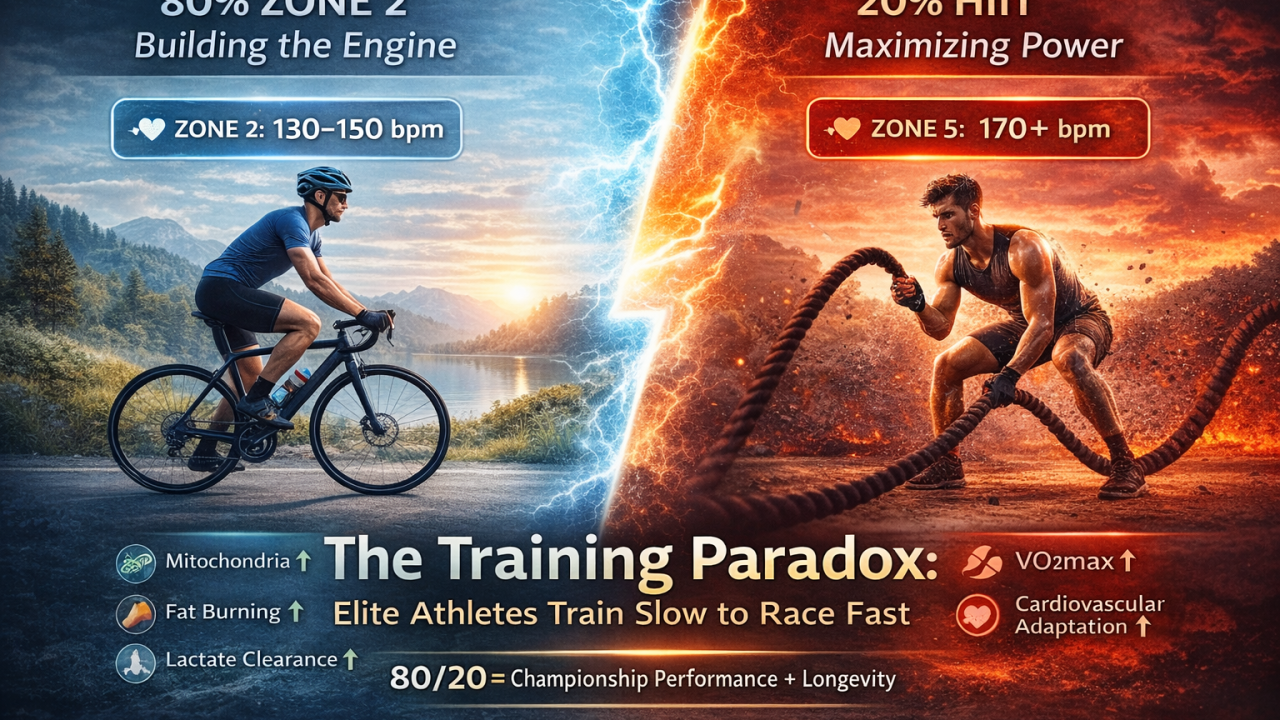
Elite athletes like Pogačar demonstrate that thousands of hours of patient Zone 2 training create the metabolic foundation for championship-level performance—the polarized training model that science increasingly validates.
The Mitochondrial Divide: How Zone 2 and HIIT Build Different Engines
To understand why both training modalities matter, we need to start at the cellular level. Dr. Martin Gibala, Professor of Kinesiology at McMaster University, has spent two decades researching how different exercise intensities affect mitochondrial adaptations. His landmark 2006 study shocked the exercise science community by demonstrating that sprint interval training could produce similar mitochondrial adaptations to traditional endurance training in a fraction of the time.
But the story gets more nuanced. Dr. San-Millán emphasizes that Zone 2 training produces fundamentally different adaptations: "Over 25 years of working with elite athletes, I have observed that Zone 2 is the exercise intensity where I see the greatest improvement in fat burning and lactic clearance capacity."
The distinction is crucial. HIIT primarily stimulates mitochondrial biogenesis—the creation of new mitochondria. Zone 2 training enhances mitochondrial function and metabolic flexibility—the ability of existing mitochondria to efficiently switch between burning fat and carbohydrates. Think of HIIT as building more power plants, while Zone 2 training optimizes how efficiently those power plants operate.
The Lactate Paradox: From Waste Product to Premium Fuel
One of the most significant paradigm shifts in exercise physiology has been our understanding of lactate. Once vilified as a metabolic waste product, lactate is now recognized as a crucial fuel source and signaling molecule. Dr. George Brooks at UC Berkeley pioneered the lactate shuttle hypothesis, demonstrating that lactate produced in working muscle can be transported to other tissues—including the heart, brain, and less-active muscle fibers—where it serves as an efficient energy substrate.
Dr. San-Millán's research with elite cyclists has shown that Zone 2 training specifically enhances the expression of monocarboxylate transporters (MCT1 and MCT4), which shuttle lactate into and out of cells. This metabolic machinery takes time to develop—explaining why elite athletes spend 80% of their training at low intensity despite competing at high intensity.
The Science of Sustainable Speed
When most recreational athletes discover HIIT, they enthusiastically replace their steady-state cardio with multiple high-intensity sessions per week. But here is the critical insight: VO₂max improvements plateau relatively quickly with HIIT, while the aerobic base built through Zone 2 training continues developing for years. Dr. Stephen Seiler coined the term polarized training to describe what champions actually do: approximately 80% of training at low intensity and 20% at high intensity.
A 2024 study in the European Journal of Preventive Cardiology, analyzing 692,217 adults, found that those who combined moderate-intensity training with some high-intensity work had the lowest mortality risk of all—validating the polarized approach not just for performance but for longevity itself.