Neuroscience
·3 min read
The Neurochemistry of Focus
How Brain Signaling Shapes Performance and Longevity
By Sydney Wiredu & Tony Medrano, CEO
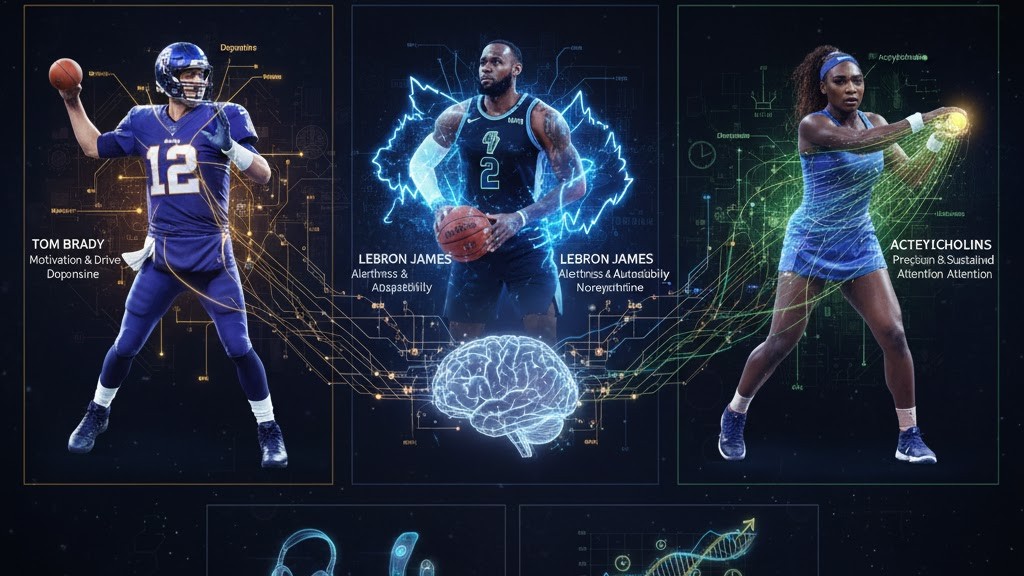
When seven-time Super Bowl champion Tom Brady takes the field at age 45, an age when most quarterbacks have long since retired, something extraordinary is happening beneath his helmet. When LeBron James maintains elite NBA performance at 40, defying the conventional wisdom that basketball players peak in their late twenties, his secret weapon isn't just physical conditioning. And when Serena Williams dominated tennis into her late thirties while managing the demands of motherhood, she wasn't just relying on power and athleticism.
These champions share a common thread: they've mastered the neurochemistry of focus. The same brain signaling systems that power their peak athletic moments also determine how gracefully—or ungracefully—the rest of us age.
 Your brain's attentional command center operates through three primary chemical messengers—dopamine, norepinephrine, and acetylcholine—each orchestrating distinct aspects of cognitive performance and longevity.
The Three Maestros of Mental Performance
Your brain's attentional command center operates through three primary chemical messengers. Dopamine, the motivation amplifier, functions as what Stanford neuroscientist Andrew Huberman calls "a propeller" for motivation and sustained focus. Its dual role in immediate performance and long-term brain health is fascinating: Dr. Caterina Rosano's team at the University of Pittsburgh found that older adults with higher striatal dopamine showed significantly less performance deterioration during sustained physical tasks, independent of muscle energetics and cardiopulmonary fitness.
Norepinephrine, the alertness engine, serves as your brain's emergency broadcast system. When Tom Brady identifies a defensive blitz in the split-second before the snap, or when a Formula 1 driver reacts to unexpected track conditions at 200 mph, norepinephrine floods their prefrontal cortex, sharpening perceptual processing and accelerating decision-making.
Acetylcholine, the precision focusing instrument, plays a vital role in learning, memory formation, and maintaining attention. Dr. Marieke Sarter at the University of Michigan notes that acetylcholine creates a "spotlight of attention" that highlights relevant stimuli while suppressing distractors—explaining how Serena Williams could track a 120 mph serve in championship matches.
Tom Brady's Brain Training Revolution
In 2014, Brady discovered BrainHQ, a cognitive training platform developed by Posit Science. What began as a program for older adults experiencing cognitive decline became a secret weapon for one of football's greatest quarterbacks. Every day, Brady powered through over two dozen cognitive exercises designed to sharpen attention, processing speed, memory, and executive function. Brady played competitively until age 45, winning his seventh Super Bowl at 43. He credits BrainHQ with giving him a competitive edge, allowing him to process defensive formations and make decisions split-seconds faster than his competition.
LeBron James and Sustained Excellence
LeBron James's approach to cognitive optimization differs but shares the same neuroscientific foundation. James is an advocate of mindfulness meditation using the Calm app. Research from Harvard Medical School has demonstrated that regular meditation practice produces measurable changes in brain structure and function—increasing gray matter density in the prefrontal cortex and hippocampus while reducing amygdala activity. The Denver Nuggets, 2023 NBA Champions, adopted Reflexion neurotraining platform-wide, and Stephen Curry uses strobe glasses to sharpen decision-making by forcing his visual system to process incomplete information.
Serena Williams: The Quiet Eye and Mental Rehearsal
Serena Williams mastered the "quiet eye" technique—an enhanced perception allowing athletes to take a keener, closer, longer look at critical targets. Dr. Joan Vickers at the University of Calgary pioneered this research, tracking eye movements and discovering that great players looked at the ball longer than others. Williams also engaged in vivid visualization every morning: "You need to see things happening and envision yourself in a fantasy world, and really believe in that fantasy world, until it comes true." Stanford neuroscientists found that mental rehearsal engages the same motor planning circuits used during actual physical execution.
The Aging Brain's Dopamine Paradox
Your brain's dopamine system doesn't simply decline with age—it adapts, recalibrates, and sometimes even upregulates in counterintuitive ways. Studies show that striatal dopamine synthesis capacity is elevated in healthy older adults relative to young adults, suggesting the brain compensates for age-related changes. The actionable insight: consistent cognitive training, meditation, regular exercise, and quality sleep all support dopaminergic and cholinergic system maintenance—building the neurological reserves to maintain cognitive vitality at 50, 70, and beyond.