Digital Health
·5 min read
Beyond the Wearable: Multi-Modal Data Fusion for Your Digital Twin
How Disparate Sensors Are Finally Learning to Speak the Same Language—And What It Means for Your Healthspan
By Arash Mirbagheri & Tony Medrano, LongevityPlan.AI
How Disparate Sensors Are Finally Learning to Speak the Same Language—And What It Means for Your Healthspan
By Arash Mirbagheri & Tony Medrano, LongevityPlan.AI
The $324 Billion Question
Picture this: You're wearing an ŌURA Ring tracking your heart rate variability, a WHOOP strap monitoring your strain and recovery, a Garmin watch measuring your VO2 max, and you've just uploaded blood biomarkers from your latest Function Health panel. You possess more data about your cardiovascular and respiratory health than most Olympic athletes had access to a decade ago. There's just one problem—none of them talk to each other.
This isn't just an inconvenience for data nerds; it is the central challenge holding back the promise of personalized preventive medicine. The healthcare wearables sector is projected to explode from $103.4 billion in 2025 to $324.73 billion by 2032, yet we are largely operating with disconnected data silos.
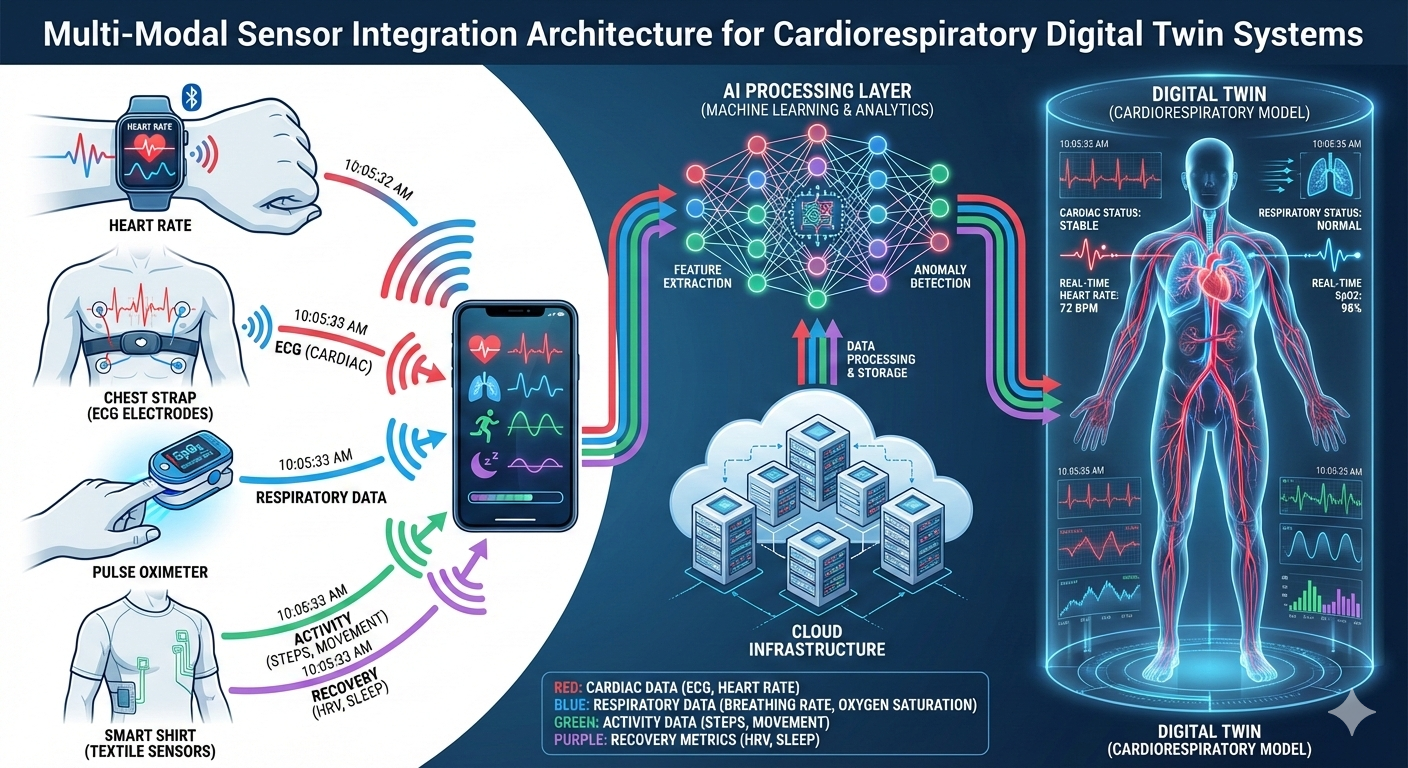
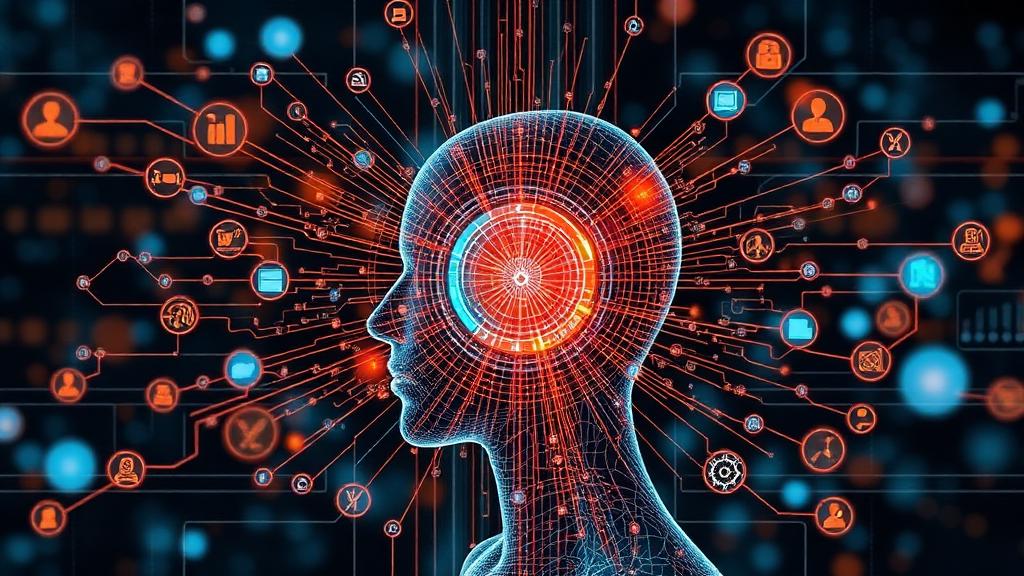 Multi-modal sensor integration architecture combining consumer wearables, medical-grade sensors, and AI-powered cloud processing to create a comprehensive cardiorespiratory digital twin.
What Is Multi-Modal Data Fusion?
To build a "Digital Twin"—a virtual representation of your physiology continuously updated with clinical and real-world data—sensors must learn to speak the same language. Dr. Yunus Celik and Professor Alan Godfrey from Northumbria University identified three fundamental levels of sensor fusion in npj Digital Medicine: Signal-Level Fusion (combining raw data before processing), Feature-Level Fusion (extracting meaningful characteristics from each sensor then combining them), and Decision-Level Fusion (each sensor system makes its own assessment, then assessments are combined using voting, averaging, or Bayesian inference).
"For instance, quantifying daily heart rate is useful, but without considering other outcomes such as physical activity levels or sleep quality, it may be meaningless to gauge the true impact of daily activities on overall health or treatment interventions," write Celik and Godfrey. Their point is profound: isolated data points are interesting; integrated data creates actionable intelligence.
The Cardiorespiratory Digital Twin
Dr. Eric Topol, founder of the Scripps Research Translational Institute and one of the most-cited researchers in medicine, laid out the vision in Nature Medicine: "The increasing availability of biomedical data from large biobanks, electronic health records, medical imaging, wearable and ambient biosensors, and the lower cost of genome and microbiome sequencing have set the stage for the development of multimodal artificial intelligence solutions." Recent research synthesized 183 studies identifying a four-layer architecture: Data Layer, Analysis Layer, Decision Support Layer, and Simulation Layer—a framework that "flags silent pathology weeks in advance and steers proactive personalized prevention."
The Metrics That Matter: VO2 Max and HRV
Dr. Peter Attia, the longevity medicine physician trained at Johns Hopkins University, states: "Your VO2 max is more strongly correlated with your lifespan than any other metric I can measure." The 2018 JAMA Network Open study of 122,007 patients showed that improving from 'low' to 'below average' fitness was associated with a 50% mortality reduction. Heart rate variability provides "a window into your nervous system," as Andrew Huberman explains on the Huberman Lab podcast. Just six minutes per day of slow-paced diaphragmatic breathing can measurably boost HRV through respiratory sinus arrhythmia—signal-level fusion in action. Devices like the Heartmath Inner Balance or Apollo Neuro provide biofeedback loops for optimizing HRV.
Real-World Implementations
Northwestern University & Sibel Health
Professor John A. Rogers at Northwestern University and director of the Center for Bio-Integrated Electronics has pioneered "epidermal electronic systems"—wireless, battery-free devices that adhere to skin using Van der Waals forces alone. These devices have been deployed by Sibel Health to over 20,000 locations in India, Pakistan, and Zambia.
Mayo Clinic & IBM
Mayo Clinic's collaboration with IBM Research has produced deep learning models that analyze ECG patterns in conjunction with electronic health records to predict left ventricular dysfunction with an AUC exceeding 0.92—higher than most cardiologists' clinical assessments.
Google Health & Fitbit
Google's acquisition of Fitbit brought consumer wearables under the same roof as DeepMind's AI capabilities. Researchers used Fitbit data from 22 individuals with Pulmonary Arterial Hypertension to demonstrate that "additional free-living physical and cardiovascular functions can provide much more detailed information than daily step counts alone."
UK Biobank: 3,500 Cardiac Digital Twins
Researchers led by Dr. Charlène Mauger at the University of Auckland constructed 3,461 cardiac digital twins from UK Biobank participants—published in Nature Cardiovascular Research in May 2025—challenging conventional wisdom about sex-specific cardiac differences.
The Interoperability Challenge
Consumer wearables face sampling frequency mismatches (ECG at 1,000 Hz vs. step counter updating once per minute), data format incompatibilities despite HL7 FHIR standards, and privacy-utility paradoxes. But federated learning and blockchain-based solutions are emerging paths forward. The Digital Medicine Society (DiMe) has proposed the "V3" Framework: Verification, Analytical Validation, and Clinical Validation.
The Mitochondrial Connection
Dr. Iñigo San Millán, exercise physiologist at the University of Colorado and consultant to professional cycling teams, emphasizes that VO2 max improvement is fundamentally about mitochondrial biogenesis: "When we talk about Zone 2 training, we're really talking about maximizing fat oxidation at the mitochondrial level."
The question isn't whether multi-modal fusion will transform health—it's how quickly we can solve the engineering challenges to make it accessible to everyone.