Performance
·5 min read
The Key to Speed
Leveraging AI to Develop Sustainable Sprinting
By Catherine Littlewood & Tony Medrano, CEO
The difference between a 9.58-second 100-meter dash and a career-ending hamstring tear often comes down to millimeters. Specifically, where your foot strikes the ground and how efficiently force transfers through the kinetic chain. It is no secret that elite sprinting isn't just about raw power, but about mechanical precision, neuromuscular coordination, and the sustainability of movement patterns under extreme loads. Currently, the rise of artificial intelligence and biomechanical modeling are revealing the subtle technical signatures that separate career longevity from chronic injury.
Precision biomechanical analysis reveals that elite sprinters maintain foot-strike consistency within 2-3 centimeters across consecutive steps, compared to 8-12 centimeters in developing athletes—a difference that predicts both performance and injury risk.
The Biomechanical Foundation: Where Speed Meets Sustainability
Traditional sprint coaching emphasized maximum force production: push harder, drive longer, generate more power. But research from the University of Bath and Loughborough University reveals a more nuanced reality: sprint performance depends not on how much force you produce, but how economically and precisely that force is delivered into the ground.

Dr. Jean-Benoît Morin, professor at Université Jean Monnet Saint-Étienne, has spent two decades quantifying force-velocity profiles in elite sprinters. His research demonstrates that the ratio of horizontal to total ground reaction force—what biomechanists call the "force application technique"—predicts both sprint performance and injury risk with remarkable accuracy. "We're seeing that athletes who can maintain optimal force orientation through the acceleration phase experience 40% fewer soft-tissue injuries over a competitive season," explains Dr. Morin. "The data shows that technical efficiency isn't just about going faster, it's about staying healthy enough to train consistently."
This finding has profound implications beyond elite athletics. The same biomechanical principles that protect professional sprinters apply to weekend warriors, masters athletes, and aging adults seeking to maintain functional mobility. Movement efficiency isn't just a performance metric—it's a longevity biomarker.
The Ground Contact Paradox
Recent findings from the Norwegian School of Sport Sciences challenge conventional sprint wisdom. Dr. Thomas Haugen analyzed ground contact patterns in Olympic-level sprinters and discovered a counterintuitive pattern: the fastest athletes don't necessarily produce the highest peak forces. Instead, they demonstrate superior impulse efficiency—generating optimal force magnitude in minimal contact time while maintaining precise foot placement.
The research identified that elite sprinters achieve ground contact times under 90 milliseconds during maximum velocity phases, compared to 110–120 milliseconds in sub-elite athletes. But more importantly, the foot-strike location relative to the body's center of mass varied by only 2–3 centimeters across consecutive steps in elite athletes, versus 8–12 centimeters in developing sprinters.
This consistency is protective. Variable foot placement creates asymmetric loading patterns that accumulate across thousands of ground contacts, eventually manifesting as hamstring strains, Achilles tendinopathy, or stress fractures. Over a competitive season, an elite sprinter executing 50,000+ high-intensity ground contacts must maintain mechanical precision across every repetition—a standard that parallels the consistency required for longevity optimization in daily movement patterns.
AI-Powered Biomechanical Analysis: From Lab to Field
The translation of biomechanical research into practical training interventions has historically been limited by measurement constraints. Motion-capture laboratories provide exquisite detail but lack ecological validity. Field-based GPS systems track gross movement patterns but miss the subtle kinematic signatures that matter most. Now, computer vision and machine learning are bridging this gap.
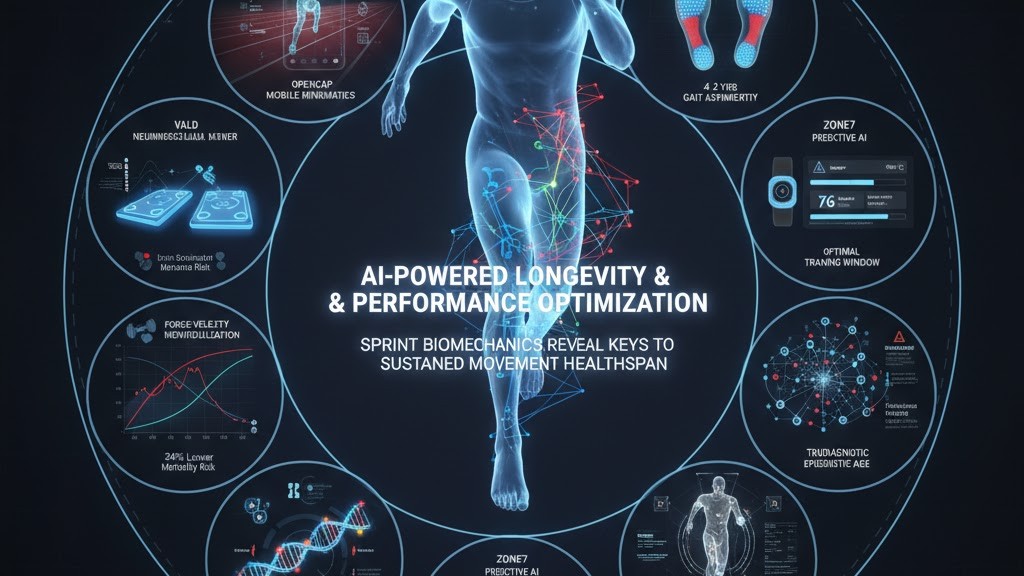
OpenCap, developed collaboratively by Stanford University and Harvard University, represents a paradigm shift in biomechanical assessment. The open-source platform uses synchronized smartphone video and AI pose-estimation models to reconstruct 3D kinematics with accuracy approaching laboratory-grade motion capture. Dr. Scott Delp, who directs Stanford's Biomechanical Engineering Laboratory, explains: "We're now able to measure joint angles, ground reaction forces, and muscle-tendon loading patterns during actual sprint training sessions. Athletes can receive immediate feedback on technique deviations that would have required weeks of laboratory analysis just five years ago."
The system employs deep neural networks trained on millions of annotated human movement frames to track anatomical landmarks frame-by-frame, then applies musculoskeletal modeling algorithms to estimate internal loading. But OpenCap's implications extend far beyond elite sprinting. The platform is being validated as a healthspan measurement tool—quantifying movement quality metrics that correlate with biological aging, fall risk, and functional independence preservation.
The Force-Velocity Profile: Individualizing Sprint Development
Not all sprinters are created equal, and that's precisely the point. Research from Dr. Pierre Samozino at Université Savoie Mont Blanc established that elite sprinters exhibit diverse force-velocity profiles despite similar performance outcomes. Some athletes are "force-dominant" producers, generating high forces at lower velocities. Others are "velocity-dominant," producing relatively lower forces but applying them at higher movement speeds.
The optimal training intervention for improving sprint performance depends entirely on an athlete's individual profile. Force-dominant athletes benefit from plyometrics and technique work emphasizing shorter ground contacts and faster limb velocities. Velocity-dominant athletes require heavy resistance training to shift their profile toward greater force production. This individualization principle applies equally to longevity optimization—just as sprinters require personalized training based on their force-velocity phenotype, aging adults benefit from customized interventions addressing their specific neuromuscular deficits.
Wearable Technology: Precision Monitoring for Performance and Healthspan
STATSports, the Northern Irish GPS company worn by athletes across the NFL, NBA, and international football, has refined high-speed movement profiling through their Apex system. For sprint-intensive sports, it quantifies "maximum velocity profiling"—tracking not just how fast athletes run, but how frequently they approach peak velocities, how quickly they accelerate and decelerate, and how these patterns accumulate across training microcycles.
Research from Leeds Beckett University demonstrates that masters athletes (ages 40–65) who maintain weekly high-speed running volumes—even brief 20–30 meter accelerations—preserve fast-twitch fiber populations and maintain power output into their 60s at levels matching sedentary individuals 20 years younger. The key is dosage precision: 2–3 sprint sessions weekly, totaling 200–400 meters of high-intensity distance, provide optimal stimulus.
Meanwhile, Plantiga embedded pressure sensors and inertial measurement units directly into shoe insoles, creating a wearable force-measurement system that captures ground contact time, peak force, loading rate, center-of-pressure progression, and left-right asymmetries during every footstrike. Machine learning algorithms trained on thousands of athletes' movement signatures detect subtle gait deviations that precede injury—making biomechanical precision accessible far beyond the elite performance lab.