AI & Health
·3 min read
The Digital Revolution in Cancer Care
How AI and Longevity Science Are Rewriting Our Future
By Dr. Karim Godamunné, MD MBA SFHM FACHE
When actor Ben Stiller underwent a routine PSA test at age 46, he had no symptoms, no family history of prostate cancer, nothing that screamed "at risk." Yet his doctor insisted on the screening. That test saved his life. Within weeks of the diagnosis, the cancer was surgically removed, and Stiller has been cancer-free ever since. His story encapsulates a revolution happening in cancer care—powered by early detection technologies that can identify disease years before symptoms emerge.
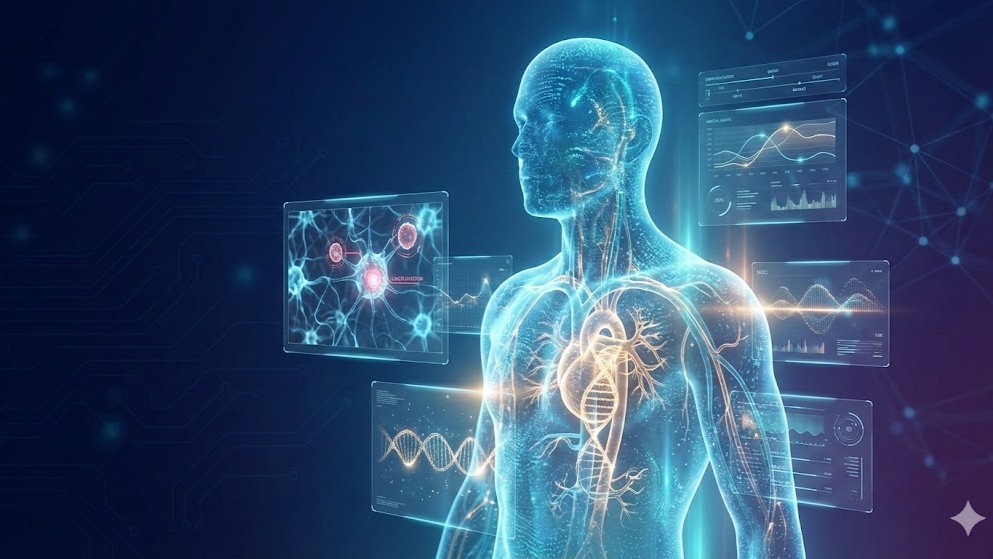
Today, cancer research stands at an unprecedented inflection point. After decades of incremental progress, we are witnessing a fundamental transformation in how we understand, prevent, and treat malignancies. This revolution is powered by two converging forces: artificial intelligence and Digital Twin technologies that can model disease with extraordinary precision, and longevity science that is revealing the deep biological connections between aging and cancer susceptibility.
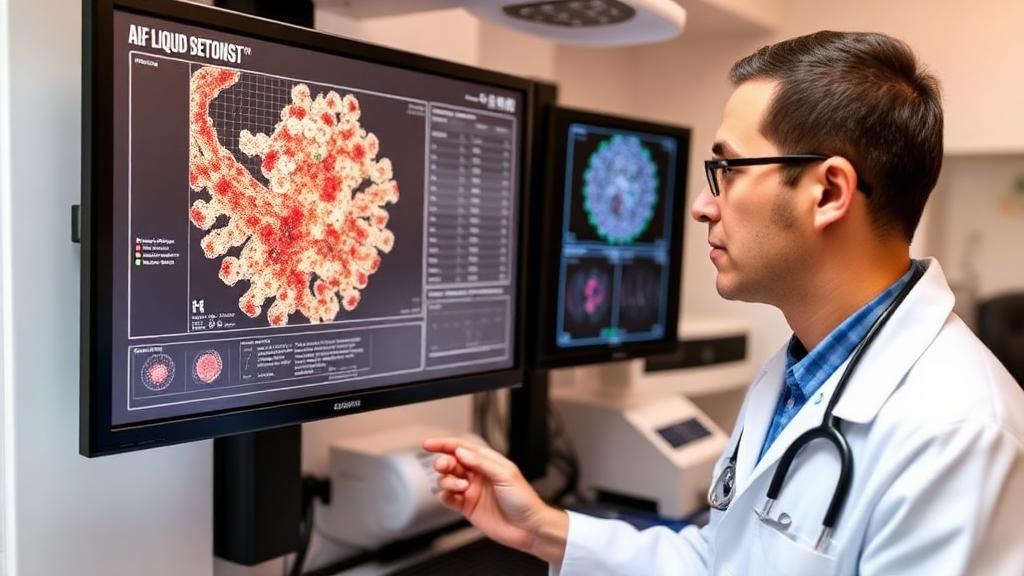
Advanced AI systems are transforming cancer detection through liquid biopsy technology, enabling multi-cancer early detection from a simple blood draw—identifying disease years before symptoms appear.
The GRAIL Revolution: Multi-Cancer Early Detection at Scale
To understand the transformative potential of AI in cancer care, consider the work at GRAIL, an Illumina spinoff that developed the Galleri test. It uses machine learning to analyze cell-free DNA circulating in the bloodstream, detecting patterns that indicate not only the presence of cancer but also its tissue of origin. In the PATHFINDER study, GRAIL technology detected cancer signals across more than 50 cancer types with a specificity of 99.5%, and correctly predicted tissue of origin in 88.7% of cases.
The longevity implications are profound. Many of the deadliest cancers—pancreatic, ovarian, esophageal—are lethal primarily because they are detected late. Pancreatic cancer has a five-year survival rate of just 11% when diagnosed at advanced stages, but that jumps to 44% for localized disease. Research from Johns Hopkins University suggests MCED tests could prevent approximately 100,000 cancer deaths annually in the United States alone.
AI-Driven Drug Discovery and the Longevity Dividend
Recursion Pharmaceuticals represents a new paradigm in drug development. Their platform combines automated cell biology experiments with deep learning, processing more than 2.5 petabytes of biological data to identify patterns invisible to human researchers. The platform screens 2.2 million experiments per week. In 2023, Recursion announced promising Phase 2 data for REC-2282, discovered entirely through their AI platform, with the timeline from discovery to clinical validation compressed to just four years—less than half the industry standard.
Digital Twins: Personalized Cancer Modeling
Perhaps the most audacious application is digital twins—computational models that replicate individual biology to predict disease progression and treatment responses. Researchers at MD Anderson Cancer Center and Memorial Sloan Kettering use these models to simulate how tumors might evolve under different treatment regimens. Early pilot studies suggest response rates 30-40% higher than standard care.
The Aging-Cancer Connection
One of the most profound insights from longevity research is that cancer and aging share fundamental biological mechanisms. Cellular senescence—where cells cease dividing but remain metabolically active—evolved as a tumor-suppressor mechanism but paradoxically promotes cancer as senescent cells accumulate with age. Studies show that clearing senescent cells from aged mice reduces cancer incidence by 60-80% and extends both healthspan and lifespan. The first human trials at Mayo Clinic using dasatinib and quercetin showed promising results, and second-generation senolytics are now in development for both lifespan extension and cancer prevention.